
Flat Tire? What to Do & How to Prevent It in Brampton
Published 10 Jun 2026 · Atika Auto Parts
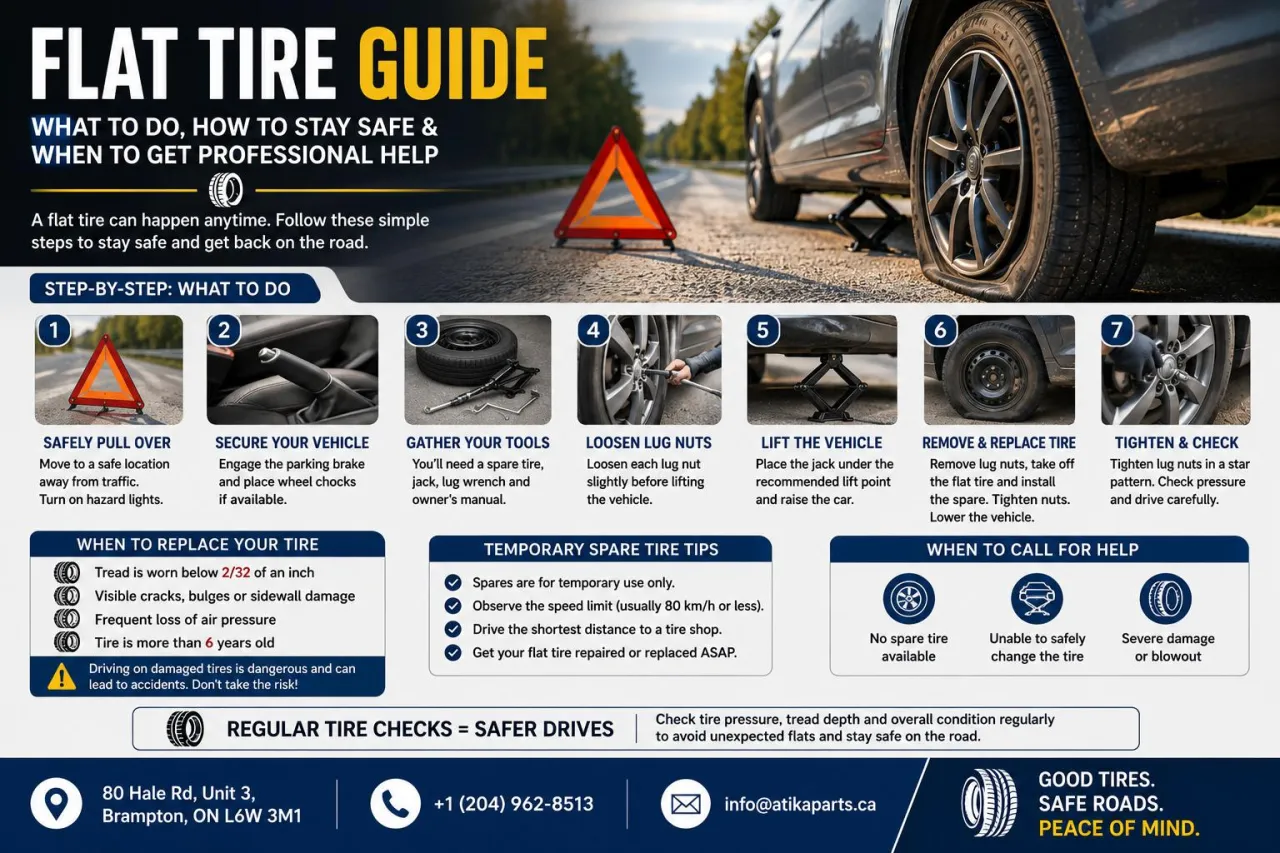
A flat tire has a way of showing up at the worst moment — merging onto the 401, pulling out of a plaza in Brampton, or heading home to Caledon after a long day. Knowing exactly what to do keeps you safe and can save the tire, while a few simple habits go a long way toward preventing flats in the first place. Here is a clear, practical guide from our team at Atika Auto Parts, serving drivers across Brampton and GTA West.
What to Do the Moment You Get a Flat
The first goal is always your safety, not the tire. If you feel a sudden pull, a thumping vibration, or hear that unmistakable flapping sound, stay calm and do the following:
- Ease off the accelerator — do not slam the brakes. Let the vehicle slow gradually while you keep a firm grip on the wheel.
- Signal and pull over to a safe, flat, level spot as far from traffic as possible. On the 401 or 407, that means the right shoulder, well past the white line.
- Turn on your hazard lights and, if you have them, set out reflective triangles or flares behind the vehicle.
- Get everyone out on the non-traffic side and stand well away from the road, especially on busy GTA West highways.
If you are in a risky location, do not attempt a roadside change — call for roadside assistance and wait in a safe place.
Do Not Drive Far on a Flat
It is tempting to limp the last few kilometres home, but driving on a flat or badly underinflated tire is one of the fastest ways to turn a repairable puncture into a write-off. Rolling on a deflated tire:
- Chews through the sidewall and internal cords, which cannot be safely repaired.
- Can damage the wheel (rim) itself, adding to your bill.
- Reduces steering control and increases the risk of a blowout.
If the tire is completely flat, stop and fit your spare or call for help. A short, slow crawl to a truly safe pull-off spot is one thing — driving several kilometres is another.
Spare, Repair, or Replace?
Once you are safe, you have a few options depending on your vehicle and the damage.
- Spare tire: Many vehicles carry a full-size spare or a compact “doughnut.” A doughnut is a get-you-there solution only — keep speeds low (usually under 80 km/h) and get to a shop soon.
- Repair: A proper plug-and-patch repair from inside the tire is often the right, cost-effective fix for a small tread puncture.
- Replace: When damage falls outside safe repair limits, a brand-new tire is the safe choice. We fit brand-new tires with expert same-day service.
Not sure which route makes sense? Our team is happy to inspect it and give you an honest recommendation. See our full tire services for what we offer.
When a Puncture Can Be Repaired — and When It Can’t
Industry safety standards are clear about what is repairable. A puncture can usually be safely repaired when:
- It is in the tread area, not the sidewall or shoulder.
- The hole is 6 mm (about 1/4″) or smaller in diameter.
- The tire still has adequate tread depth and is not aged or dry-rotted.
- There is no internal damage from being driven on while flat.
A puncture generally cannot be repaired when it is in the sidewall or shoulder, when there are multiple close punctures, when the hole is too large, or when the tire has already been run flat. In those cases, replacement is the safe call — and for peace of mind, many drivers replace in pairs on the same axle. If you are shopping around, our guide to used vs new tires in Ontario is a helpful read.
How to Prevent Flats
Most flats are avoidable with a bit of routine care. Ontario roads take a beating from freeze-thaw cycles, so potholes and debris are part of GTA West life — here is how to stay ahead of them:
- Check tire pressure monthly (and before long trips). Underinflated tires flex, overheat, and are far more prone to punctures and blowouts. Check pressure when tires are cold.
- Watch the road for potholes, curbs, and debris. When you cannot avoid a pothole safely, slow down before it — hitting it hard can pinch or crack the tire.
- Keep an eye on tread and age. Worn or old, cracked tires puncture more easily. Learn the warning signs in our tire maintenance guide.
- Rotate and inspect regularly so wear stays even and small issues are caught early.
- Do not ignore a slow leak. A tire that keeps needing air often has a nail or valve issue that is easy to fix now and expensive to ignore.
A quick visual check every couple of weeks — pressure, tread, and any embedded nails or screws — takes minutes and prevents most roadside surprises.
Flat Tire in Brampton or GTA West? We Can Help
Whether you need a puncture inspected, a repair, or a set of great-value brand-new tires at honest, fair prices, our team is ready with expert same-day fitting for drivers across Brampton, Mississauga, Caledon, Halton and Vaughan. Call us at +1 (204) 962-8513 or drop by 80 Hale Rd, Unit 3, Brampton, ON L6W 3M1. You can also get in touch here and we will get you rolling safely again.