
When to Replace New Car Factory (OEM) Tires
Published 06 Jul 2026 · Atika Auto Parts
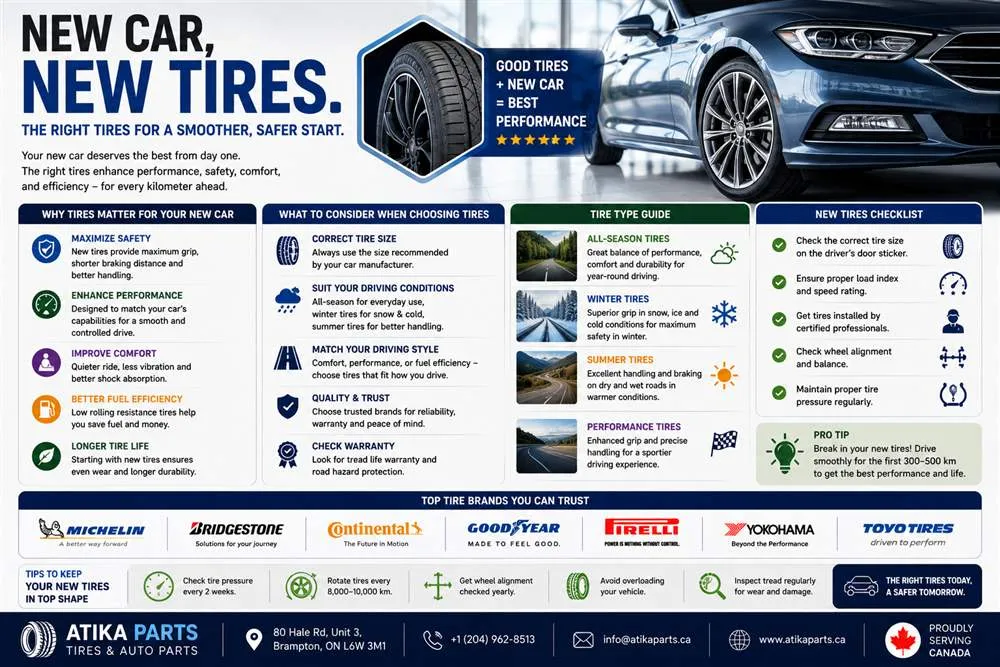
If you just drove a new vehicle off the lot, you might assume the new car factory tires underneath it will last for years. Many drivers here in Brampton and across the GTA West are surprised to find those original tires wearing out sooner than expected — sometimes well before the odometer suggests they should. Understanding why that happens, and how to spot the signs, helps you plan ahead instead of getting caught off guard on the 401 or 407.
What "factory" (OEM) tires actually are
The tires fitted at the assembly plant are called OEM tires, short for Original Equipment Manufacturer. Automakers choose these tires in bulk to hit a balance of ride comfort, low rolling resistance for fuel-economy ratings, and cost. What they are not always optimized for is long tread life. A few things worth knowing:
- OEM tires are often a "softer" compound tuned for a smooth showroom ride, which can wear faster than a comparable replacement.
- They are usually all-season tires, not designed for true Ontario winters — below roughly 7°C the rubber stiffens and grip drops off.
- Fuel-economy-focused models can trade a little tread durability for lower rolling resistance.
None of this means factory tires are bad. It simply means the set that came with your car may not last as long as the replacements you eventually choose.
Why factory tires often wear faster than expected
It is common for original tires to need replacing between roughly 40,000 and 60,000 km — and sometimes sooner. On our local roads that timeline can shrink further. Brampton and Mississauga see plenty of stop-and-go commuting, potholes after freeze-thaw cycles, and stretches of highway heat in summer, all of which speed up wear. Add in the aggressive braking and cornering that city driving demands, and a soft OEM compound simply gives up ground faster.
Driving habits matter too. Frequent hard stops, under-inflation, and skipped rotations all shorten tire life. If you want a fuller picture of what to expect, our guide on how long tires last in Ontario breaks it down by tire type and driving style.
How to check your factory tires: tread and age
You don't need special tools to judge whether your original tires still have life left. Two things matter most — tread depth and age.
- The toonie test. Insert a Canadian toonie into a tread groove. If the tread reaches the bear's paws, you have plenty left. If it only reaches the silver edge, your tires are about half worn. If it reaches the letters, replacement time is near.
- Tread-wear bars. Look for the small raised rubber bars sitting in the grooves. When the tread is flush with these bars, the tire is at its legal wear limit and should be replaced.
- Uneven wear. Feathering, cupping, or one edge wearing faster than the other can point to alignment or inflation issues — worth addressing before it ruins a set.
- The date code. Find the four-digit DOT code on the sidewall. "2223," for example, means the 22nd week of 2023. Even with good tread, rubber ages, and tires more than six years old deserve a close look.
If any of these checks give you pause, it is worth having the tires inspected in person. Our team is happy to take a look and give you an honest read on how much life is left.
Should you replace all four, or just the worn ones?
When your factory tires are ready to retire, replacing all four at once is usually the safest choice — it keeps grip and handling balanced, especially in the rain and snow we get across Caledon, Halton, and Vaughan. Mixing a brand-new tire with three half-worn OEM tires can affect stability and braking. That said, there are situations where replacing a pair makes sense. Our post on whether to replace one or all four tires walks through the trade-offs so you can decide with confidence.
Choosing quality replacements
Replacing your original tires is a chance to get a set better suited to how — and where — you actually drive. A few things to weigh:
- Match the season to your reality. If you face full Ontario winters, a dedicated set of winter tires is the safest call. For milder needs, quality all-season tires or all-weather tires may suit you better than the originals.
- Keep the correct size and rating. Stick with the size, load index, and speed rating listed on your door placard unless a professional advises otherwise.
- Consider great-value brands. You don't have to overspend to get dependable, brand-new rubber. Value brands like HAIDA (including HAIDA Runspirit, HD668, and HD737) deliver solid everyday performance at fair prices.
Because we fit only brand-new tires — never used — you can trust that what goes on your vehicle is fresh and safe. If you're planning the switch, our guide to buying new tires in Ontario and our full tire range are good places to start.
Ready to replace your factory tires? Talk to us
Whether your OEM tires are worn, aging, or just not built for our climate, the team at Atika Auto Parts can help you choose the right brand-new set and fit it the same day — expert service at honest prices for drivers across Brampton, Mississauga, Caledon, Halton, and Vaughan. Call us at +1 (204) 962-8513 or visit us at 80 Hale Rd, Unit 3, Brampton, ON L6W 3M1. Explore our full tire selection or get in touch and we'll point you to the perfect fit.