Nitrogen vs Air in Tires: Honest Verdict for Ontario
Published 06 Jul 2026 · Atika Auto Parts
If you've ever seen those green valve caps at a dealership or a tire shop, you've probably wondered whether nitrogen vs air in your tires is a decision worth paying for. It's one of the most common questions we hear from drivers across Brampton and the wider GTA West, and the honest answer isn't as dramatic as the marketing suggests. Here's a straight, no-hype look at what nitrogen actually does, what regular compressed air does, and what genuinely matters for keeping your tires safe on the 401 and 407.
What's Actually in Your Tires Right Now
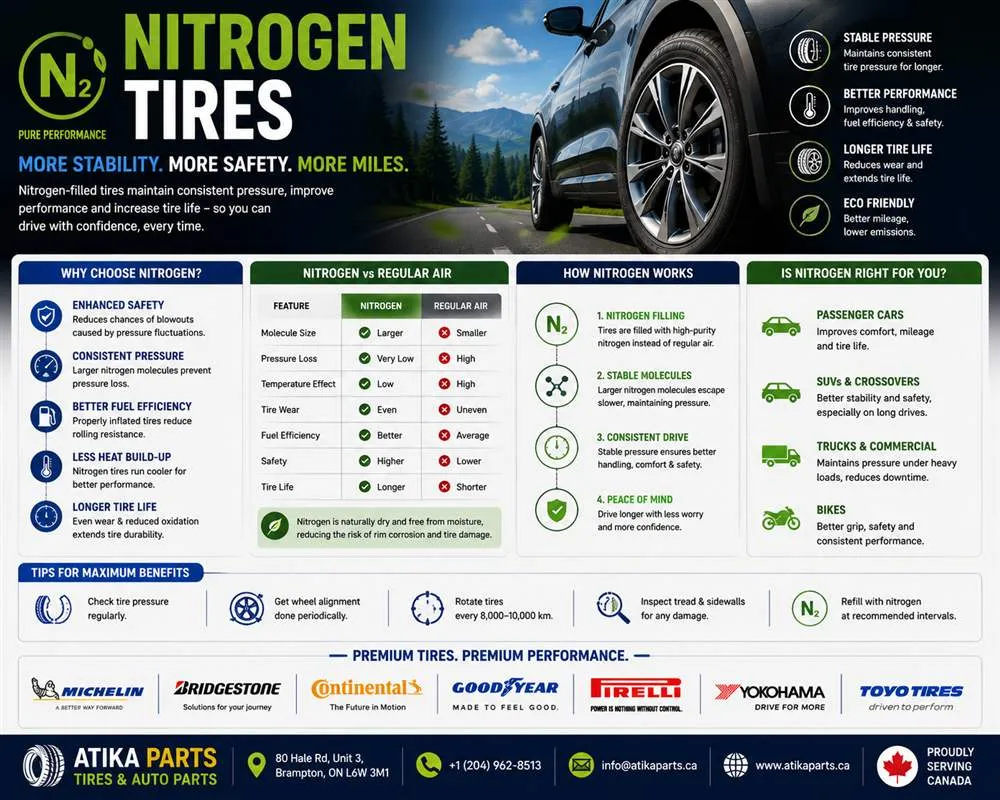
The "air" that fills most tires is roughly 78% nitrogen already. Ordinary compressed air is simply that same atmospheric mix — mostly nitrogen, about 21% oxygen, and a small amount of water vapour and trace gases. When a shop offers "nitrogen inflation," they're using equipment that strips out most of the oxygen and moisture, leaving you with a much higher concentration of nitrogen, usually 93–95%.
So this isn't a case of one mysterious gas versus another. It's a matter of degree: slightly purer nitrogen versus the everyday mix you get from any air pump. Understanding that framing takes a lot of the mystery — and the sales pressure — out of the conversation.
The Claimed Benefits of Nitrogen
Nitrogen supporters point to a few real, measurable differences. These aren't invented, but they're often overstated for the average commuter:
- Slower pressure loss. Nitrogen molecules are marginally larger than oxygen molecules, so they migrate through rubber a little more slowly. Over months, a nitrogen-filled tire may lose pressure slightly more gradually than one filled with regular air.
- Less internal moisture. Because the nitrogen process removes water vapour, there's less moisture sitting inside the tire and against the wheel. In theory this can mean less corrosion on the rim over the long term.
- More stable pressure with temperature swings. Dry nitrogen expands and contracts a touch more predictably than moist air as temperatures change — something Ontario drivers see plenty of, from −25°C in January to +30°C in July.
These points are technically true. The question is whether they translate into a benefit you'll actually notice on a Brampton commute or a weekend run out to Caledon.
The Realistic Verdict for Everyday GTA West Drivers
For fleets, motorsport, and aircraft, the small advantages of nitrogen add up and are worth the investment. For a typical car, minivan, or light truck driven around Mississauga, Halton, or Vaughan, the real-world difference is modest at best. Here's why:
- Every tire loses some pressure over time, nitrogen or not. You still need to check your pressure regularly either way.
- Once you top up a nitrogen tire with regular air — at a roadside pump, say — you've diluted the purity, so the benefits shrink.
- The corrosion and moisture advantages matter most over many years and are largely invisible to the driver day to day.
Our honest take: if your vehicle came with nitrogen and there's a convenient way to maintain it, there's no harm in keeping it. But paying a premium to chase nitrogen when good compressed air is free and everywhere usually isn't the best use of your money. We'd rather see that budget go toward quality brand-new tires and proper installation.
What Actually Matters Far More
Whatever gas is inside, two things do the heavy lifting for safety, wear, and fuel economy: correct pressure and good tires.
- Keep pressure at the manufacturer's spec. Check monthly and before long trips, always when the tires are cold. An underinflated tire wears unevenly, runs hot, and costs you fuel — regardless of nitrogen or air. Our tire pressure guide for Ontario walks through exactly how and when to check.
- Choose the right tire for the season. A well-matched set of all-season, all-weather, or dedicated winter tires does more for grip and stopping distance than any inflation gas ever could.
- Watch tread and age. Worn or aged tires are a safety risk no gas can fix. Replace them before they become a problem on wet or icy Ontario roads.
If you're due for new rubber, or you'd simply like an honest opinion on your current set, our team is happy to walk you through the options. You can also learn more about what we do on our services page.
Bottom Line
Nitrogen isn't a scam, but it isn't magic either. For most drivers across Brampton and GTA West, the small edge it offers is easily outweighed by simply keeping your pressure correct and running fresh, quality tires. Don't lose sleep over green valve caps — put your attention where it counts.
Talk to Atika Auto Parts About Your Tires
Have questions about pressure, inflation, or which brand-new tires suit your vehicle and your driving? We're glad to help — no pressure, no jargon, just honest advice and fair prices. Call us at +1 (204) 962-8513 or stop by 80 Hale Rd, Unit 3, Brampton, ON L6W 3M1 for expert same-day fitting. Browse our full range of brand-new tires or get in touch to book a visit.