
Tire Pressure Guide for Ontario: Find & Keep the Right PSI
Published 06 Jul 2026 · Atika Auto Parts
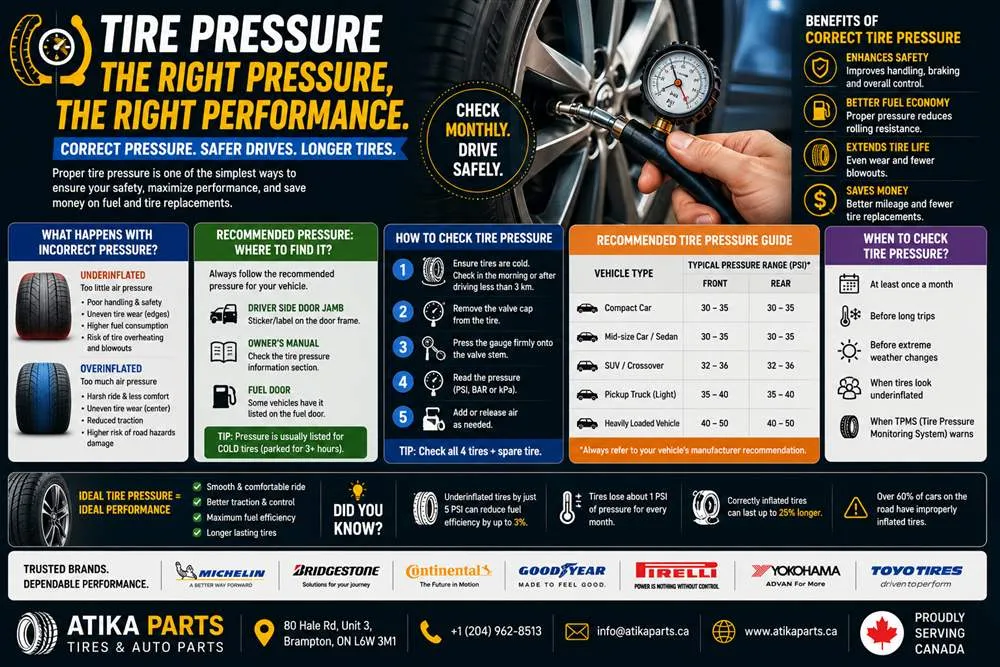
Getting your tire pressure right is one of the simplest, cheapest things you can do for your car — and one of the most overlooked. Here in Brampton and across the GTA West, our temperatures swing wildly from humid +30°C summer afternoons to bitter −25°C January mornings, and that alone can quietly pull your tires out of their ideal range without a single nail or leak. This complete tire pressure guide for Ontario walks you through finding your correct PSI, checking it the right way, adjusting for our seasons, and reading the warning signs of over- and under-inflation. Whether you drive a compact commuter down Queen Street or a loaded pickup out to Caledon, a few minutes of attention keeps you safer, saves fuel, and helps your tires last.
Why Tire Pressure Matters More Than You Think
Your tires are the only four contact patches connecting a one- to three-tonne vehicle to the road. The air inside them — not the rubber itself — carries the load. When pressure is correct, that contact patch is shaped exactly the way the engineers intended, which means predictable steering, proper braking distances, and even tread wear. When pressure drifts, everything downstream changes: how the car grips in a Brampton rainstorm, how far it takes to stop, how much fuel it burns, and how quickly the tread wears out.
Under-inflation is the more common and more dangerous problem. A soft tire flexes more at the sidewall, builds up heat, and wears its outer edges prematurely. Over-inflation is the opposite — a hard, over-pumped tire rides on its centre, wears down the middle, and transmits every pothole straight into the cabin. Both cost you money and grip. The good news is that the fix is free and takes minutes.
Finding Your Correct PSI: Door Jamb, Not Sidewall
The single most important rule in this whole guide: use the pressure your vehicle manufacturer recommends, not the number moulded into the tire's sidewall. These are two completely different things, and confusing them is the most common tire pressure mistake we see.
- The door-jamb placard — a small sticker usually inside the driver's door frame (sometimes inside the fuel door or glovebox) — lists the correct cold inflation pressure for your car's front and rear tires, chosen by the automaker for your exact vehicle's weight, handling, and ride. This is the number you want, typically in the 30–36 PSI range for passenger cars.
- The sidewall number (e.g. "Max. Press. 51 PSI") is the tire's maximum pressure — the ceiling the tire can safely hold, not a target. Inflating to the sidewall max will over-inflate most cars, giving you a harsh ride and centre wear.
If your door placard is missing or unreadable, check your owner's manual, or call us at Atika Auto Parts and we'll help you find the right figure for your make and model. If you've moved to a different tire size than the factory fitment, the correct pressure can differ — understanding how to read your tire size and its load index helps here, and we're happy to advise.
Cold vs. Hot: When and How to Check
Tire pressure specifications are always given as cold pressures, and that word matters. "Cold" doesn't mean winter — it means the tires haven't been driven on recently and are at the surrounding air temperature. As you drive, friction and flexing heat the tires, the air inside expands, and the pressure reads higher — often 3 to 5 PSI higher after a highway run down the 410.
To get an accurate reading:
- Check first thing in the morning, before driving, or after the car has sat for at least three hours.
- If you must check after driving, do it before you've gone more than about a kilometre or two.
- Never bleed air out of a hot tire to hit the placard number — once it cools, it will be under-inflated. Set pressures cold.
A note on where you check: filling at a gas station after driving there means your tires are already warm. If you inflate warm tires to the cold spec, you'll be under-inflated the next morning. A reliable pocket gauge kept in the glovebox, used in your own driveway, is more accurate than most public air machines.
How Ontario's Temperature Swings Change Your Pressure
This is where GTA West drivers get caught out. Air contracts as it cools and expands as it warms, so tire pressure moves with the outside temperature — roughly 1 PSI for every 5–6°C of change. Our climate makes that a bigger deal than in milder places.
Picture a real Brampton scenario. You set your tires to a proper 34 PSI on a mild +15°C October afternoon. A cold snap arrives and the morning drops to −15°C — a 30°C swing. That's roughly 5 to 6 PSI lost, so your tires are now sitting near 28 PSI: noticeably under-inflated, wearing their edges, and burning extra fuel, even though not a molecule of air has actually leaked out. This is exactly why so many TPMS lights come on during the first cold week of winter.
The reverse happens in spring and summer: a tire set on a frosty morning will read several PSI higher on a hot July afternoon. The practical takeaways for Ontario:
- Re-check and top up your pressures whenever the season turns — especially heading into late fall.
- Don't panic if a summer heat wave pushes readings a couple of PSI over the placard; set them cold in the morning and they'll settle.
- A low-pressure warning on the first cold day is usually temperature, not a puncture — but always verify, because it can be both.
Because pressure and seasonal grip go hand in hand, it's worth pairing this habit with your seasonal tire plan. Our guides on all-season vs. winter tires in Ontario and when to install winter tires explain why the ±7°C rule drives both decisions.
The Real Costs of Under- and Over-Inflation
It's easy to shrug off "a few PSI," so here's what those few PSI actually do.
Under-inflation is the costlier and riskier of the two:
- Wear: The tire rides on its outer shoulders, scrubbing away the edges of the tread and shortening tire life.
- Fuel: A soft tire has more rolling resistance, so your engine works harder — even 5–6 PSI low measurably raises fuel consumption over a year of GTA commuting.
- Heat & safety: Excess sidewall flexing builds heat, the leading cause of sudden tire failure, particularly on hot highway runs with a loaded vehicle.
- Handling: Vague, mushy steering and longer stopping distances, exactly when you need grip most.
Over-inflation is less dramatic but still real:
- Centre wear: The tread crowns and wears out the middle first, again cutting tire life short.
- Harsh ride: A rock-hard tire transmits every crack and pothole — and our roads have plenty.
- Reduced grip: A smaller contact patch means less rubber on the road and easier skidding on wet or icy surfaces.
Uneven wear from chronic mis-inflation is permanent — you can't re-grow tread. Catching it early with regular checks and proper rotation is what lets a good set of tires reach its full lifespan. For the bigger picture, our tire maintenance guide ties pressure together with rotation, alignment, and inspection.
TPMS: What That Light Really Means
Most vehicles sold in Canada in recent years have a Tire Pressure Monitoring System (TPMS) — the horseshoe-shaped warning light with an exclamation mark. It's a helpful safety net, but it's important to understand its limits.
- It's a warning, not a gauge. A direct TPMS typically only illuminates once a tire is roughly 25% below the recommended pressure — well past the point where wear and fuel penalties begin. A tire can be meaningfully soft and still not trip the light, which is why you shouldn't rely on it alone.
- A steady light means one or more tires are low — check all four with a gauge and inflate to spec.
- A flashing light (usually for 60–90 seconds at startup, then steady) signals a system or sensor fault, not necessarily low pressure. This often means a dead sensor battery or a sensor damaged during a tire change.
- Cold-morning trigger: As covered above, the light frequently appears on the first cold day purely from temperature. Top up to the correct cold pressure and it should clear after a short drive.
A few practical points for Ontario drivers: TPMS sensors live inside the wheel and can be worth having checked when tires are swapped seasonally, and if your vehicle uses direct sensors, the system may need to relearn after a rotation or wheel swap. If your light won't clear after you've properly inflated all four tires, bring the car to us and we'll diagnose it — a persistent light usually points to a sensor rather than a leak.
Don't Forget the Spare — and Seasonal Sets
The tire people forget is the one they need most: the spare. A full-size or compact spare slowly loses pressure sitting in the trunk, and there is nothing worse than changing a flat on the shoulder of Highway 407 only to find your spare is flat too. Check it when you do your seasonal swap. If you run a temporary "donut" spare, note that these often require a much higher pressure (around 60 PSI) — check the label on the spare itself.
If you keep two sets of tires — a smart move in our climate — remember that each set has its own correct pressure based on the same door-jamb spec, and that a winter set stored in a cold garage will need topping up once mounted. Whichever tires are on the car, the placard number is your target, set cold.
A Simple Tire Pressure Checking Routine
You don't need to be a mechanic. Here's a routine that keeps you covered year-round:
- Buy a decent gauge. A quality digital or dial pocket gauge costs little and beats the built-in gas-station machines for accuracy. Keep it in the glovebox.
- Check monthly, cold. Once a month, in your driveway before driving, check all four tires. Tires can lose 1–2 PSI a month naturally through the rubber, so this alone catches slow drift.
- Check at every season change. Spring, summer, fall, and especially the first cold snap — adjust to the placard.
- Check before long trips or heavy loads. Heading to cottage country or towing? Confirm pressures first. Some vehicles list a higher "loaded" pressure on the placard.
- Don't skip the spare. Add it to your seasonal routine.
- Inspect while you're there. A quick look for uneven wear, cracks, bulges, or embedded objects turns a two-minute pressure check into a full safety habit.
Do this, and you'll catch a slow leak before it strands you, keep your fuel bills down, and get every kilometre your tires are designed to give. If you'd rather have it done, any visit to our Brampton shop — a rotation, a seasonal swap, a quick tune-up — is a chance for us to set your pressures properly at no fuss.
Frequently Asked Questions
What is the correct tire pressure for my car?
Use the number on your vehicle's door-jamb placard (inside the driver's door frame) or in the owner's manual, not the maximum pressure moulded on the tire sidewall. For most passenger cars this is around 30–36 PSI, set when the tires are cold.
Should I check tire pressure when tires are hot or cold?
Always check and set pressure when tires are cold, meaning before driving or after the car has sat for at least three hours. Driving heats the tires and raises the reading by 3–5 PSI, so a hot reading will be misleadingly high.
Why does my tire pressure warning light come on in cold weather?
Air contracts as it cools, and tire pressure drops about 1 PSI for every 5–6°C. Ontario's sharp temperature drops can pull pressures below the TPMS threshold on the first cold morning even with no leak. Top up to the correct cold pressure and the light should clear after a short drive.
Can I just inflate my tires to the number on the sidewall?
No. The sidewall number is the tire's maximum safe pressure, not the recommended pressure for your vehicle. Inflating to that ceiling will over-inflate most cars, causing a harsh ride, centre tread wear, and reduced grip. Use the door-jamb figure instead.
How often should I check my tire pressure in Ontario?
Check monthly and at every season change, especially heading into winter, plus before long trips or heavy loads. Tires naturally lose 1–2 PSI a month, and our large temperature swings make seasonal checks especially important.
Does tire pressure affect fuel economy?
Yes. Under-inflated tires have more rolling resistance, so your engine works harder and burns more fuel. Keeping tires at the correct pressure is one of the easiest ways to lower fuel consumption and reduce uneven tread wear over the life of the tires.
Right Pressure, Right Tires — Visit Atika Auto Parts in Brampton
Correct pressure keeps good tires performing, but no amount of air can save tread that's worn out or the wrong type for the season. When it's time to replace, Atika Auto Parts stocks brand-new tires at honest, fair prices — including great-value HAIDA lines — with expert same-day fitting for drivers across Brampton, Mississauga, Caledon, Halton, and Vaughan. Explore our all-season tires and winter tires, and we'll set your new set to the proper pressure before you drive off. Call us at +1 (204) 962-8513, visit us at 80 Hale Rd, Unit 3, Brampton, ON L6W 3M1, or contact us to book your fitting today.