
All-Season vs Winter Tires in Ontario: The Full Guide
Published 01 May 2026 · Atika Auto Parts
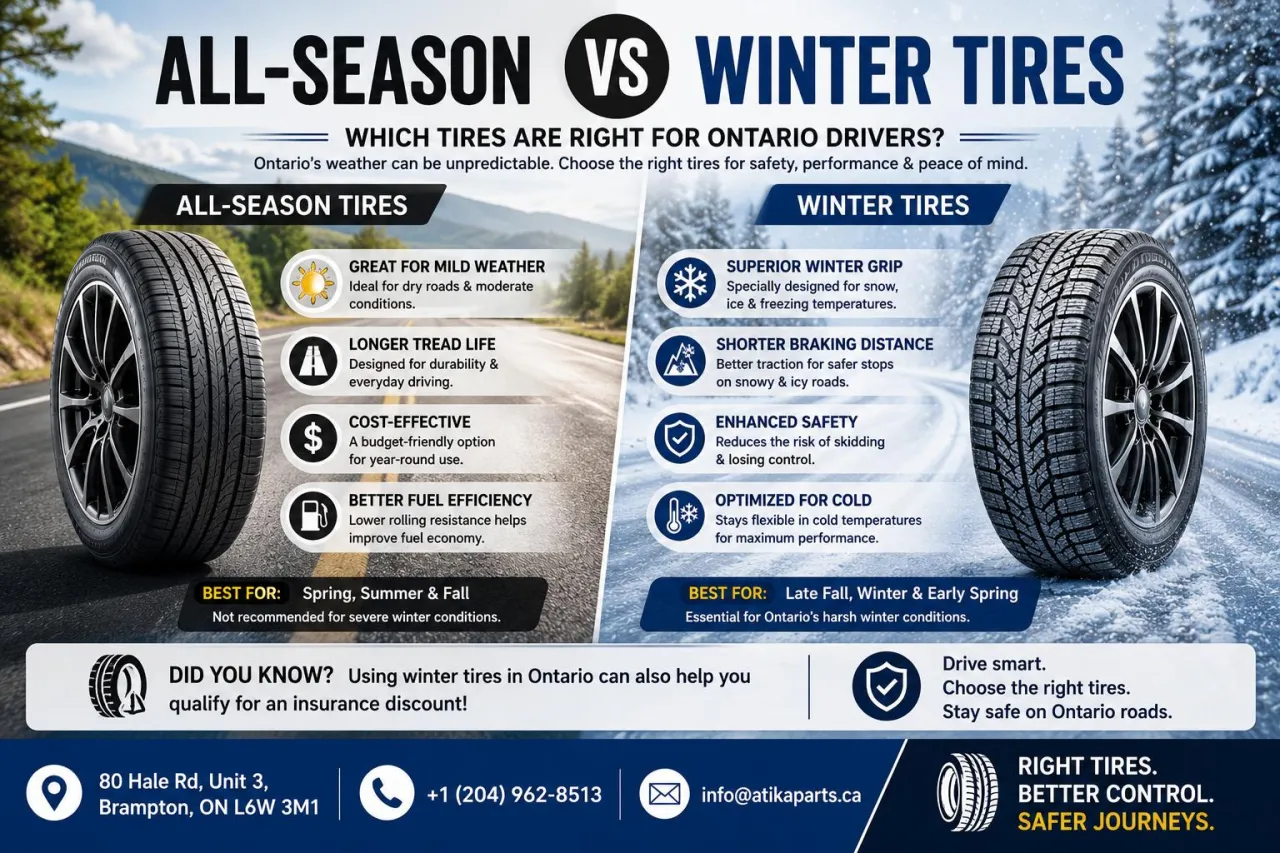
If you drive through an Ontario winter, the question of all-season vs winter tires is one of the most important safety decisions you'll make all year — and here in Brampton and across the GTA West, it comes up every autumn like clockwork. The short version is that "all-season" tires are really three-season tires, and once temperatures drop, a proper set of winter tires does things on snow and ice that an all-season simply cannot. But the full picture involves rubber chemistry, tread design, cost, insurance discounts, and how you actually drive. At Atika Auto Parts on Hale Road, we fit brand-new tires for drivers across Brampton, Mississauga, Caledon, Halton and Vaughan, so let's walk through everything you need to decide with confidence.
The Core Difference Is Rubber, Not Just Tread
Most people assume the difference between an all-season and a winter tire is the chunky tread pattern. Tread matters, but the more important difference is invisible: the rubber compound. All-season tires use a harder compound designed to last through hot summers and resist wear on warm pavement. That same hardness works against you when it gets cold. As the temperature falls, all-season rubber stiffens and loses its ability to conform to the road surface, so grip drops off sharply.
Winter tires use a softer, silica-rich compound engineered to stay pliable in the cold. A flexible tread can press into the tiny irregularities of a snowy or icy road and generate the friction you need to accelerate, corner and — most importantly — stop. This is why a winter tire outperforms an all-season on a bone-dry but freezing road, not just in fresh snow. It's a chemistry advantage as much as a tread advantage.
The 7°C Rule Every Ontario Driver Should Know
Here's the single most useful number in this whole conversation: 7°C. That's roughly the temperature at which all-season rubber begins to harden and lose meaningful grip, and it's the point at which winter rubber starts to shine. It doesn't need to be snowing. A crisp, dry morning at 3°C in Brampton is already firmly in winter-tire territory.
The 7°C rule is why the calendar can mislead you. Late October and even early November can feel mild, but overnight lows and early-morning commutes across the GTA West routinely dip below that threshold long before the first real snowfall. If you're relying on the sight of snow to trigger your tire swap, you've likely already spent weeks driving on rubber that isn't performing. For more on timing this right, see our guide on when to install winter tires in Ontario.
Tread Design & Siping: Why Winter Tires Bite
Once the compound is right, tread geometry does the rest. Winter tires are engineered with a few specific features that all-season tires either lack or under-emphasize:
- Deep, aggressive tread blocks with wide grooves that channel slush and snow out from under the contact patch so the tire keeps touching the road instead of floating on packed snow.
- Siping — the dense network of tiny zig-zag slits across each tread block. Each sipe edge acts like a little claw, biting into snow and ice. A winter tire can have thousands of these; an all-season has comparatively few.
- Snow-on-snow traction, where snow packed into the tread actually grips fresh snow better than rubber alone. Winter tread patterns are shaped to trap and use this to your advantage.
All-season tread is optimized for a balance of dry handling, wet grip, tread life and low noise across mild conditions. It's a genuinely good compromise for spring through fall — it just isn't built for the specific demands of a Canadian winter.
Braking & Traction: The Numbers That Matter on Snow & Ice
The place the difference becomes life-and-death is stopping distance. On packed snow and ice, a set of winter tires can bring your vehicle to a halt in a substantially shorter distance than all-seasons — often the difference between stopping behind the car ahead and sliding into it. That gap widens the colder and slicker the road gets, because it stacks the compound advantage on top of the tread advantage.
Traction on launch and grip through corners follow the same pattern. Pulling away from a stop on a snowy Brampton side street, climbing an icy on-ramp, or holding your line around a slushy curve in Caledon are all easier and more predictable on winters. It's worth stressing that all-wheel drive does not change this. AWD helps you accelerate by sending power to more wheels, but braking and cornering grip come entirely from the four contact patches of rubber on the road. An AWD crossover on all-seasons still stops and turns like it's on all-seasons. Tires are what actually touch the ground.
The All-Weather Middle Ground (3PMSF)
There's a third option that confuses a lot of drivers, and it deserves a clear explanation: all-weather tires. These are a genuine middle category, not a marketing rebrand of all-season. The key is the 3PMSF symbol — the three-peak mountain snowflake stamped on the sidewall. That symbol certifies the tire has met a minimum snow-traction standard in testing. All-weather tires carry it; standard all-season tires do not.
An all-weather tire uses a more cold-flexible compound and a more aggressive tread than an all-season, so it stays legal and capable in snow year-round. The trade-off is that it's a compromise in both directions: it won't match a dedicated winter tire in the harshest conditions, and it typically wears a little faster in summer heat than a true all-season. But for the right driver, running one set of 3PMSF-rated tires all year is a sensible, hassle-free choice. We break down that decision in detail in our all-weather vs all-season comparison, and if you're leaning that way you can browse brand-new all-weather tires here.
The Cost Question: Two Sets vs One
The obvious objection to winter tires is money — buying a second set feels like doubling your cost. In practice the math is friendlier than it looks, and here's why:
- You're not wearing out two sets at once. While your winters are on for four to five months, your all-seasons are sitting in storage, not aging on the road. Total tread wear across both sets is spread over more years, so you replace each set less often.
- Winter tires protect your all-seasons from the worst road salt, slush and cold-cracking, which can extend their usable life.
- Mounting on a dedicated second set of rims makes each seasonal swap faster and cheaper, and avoids repeated tire-machine wear on your good summer wheels.
Value brands change the equation, too. We carry lines like HAIDA — including the HAIDA Runspirit, HD668 and HD737 — that let you get properly matched, brand-new seasonal sets at honest, fair prices rather than paying a premium badge tax. If you'd like a candid look at what these tires deliver, read our HAIDA value-tire review. And whichever route you choose, looking after your rubber stretches every dollar — our tire maintenance guide covers how.
The Insurance Discount Most Ontario Drivers Miss
Here's a benefit that often gets overlooked: in Ontario, auto insurers are required to offer a winter tire discount to drivers who install a full set of winter tires. The exact amount varies by insurer, but it's a recurring annual saving that helps offset the cost of the tires over time. To qualify you generally need a genuine set of four winter (3PMSF-rated) tires, and your insurer may ask for proof such as an installation receipt.
The practical takeaways are simple: install a matched set of four winter tires (never just two — mixing winters on one axle and all-seasons on the other creates dangerous handling imbalance), and keep your receipt so you can claim the discount. If you buy and fit your set with us, we can provide the documentation you need. It won't make winter tires free, but it meaningfully narrows the gap versus running all-seasons year-round.
When to Switch — And When to Switch Back
Timing your seasonal swap around the 7°C rule rather than the first snowflake is the whole game. As a practical rhythm for the GTA West:
- Install winters in mid-to-late October, once daytime highs are consistently dipping toward single digits and overnight lows are already there. Booking early beats the November rush when every shop in Brampton is slammed.
- Switch back to all-seasons in April, once nighttime temperatures reliably stay above 7°C. Running winter tires deep into a warm spring wears their soft compound quickly and costs you grip on hot, dry pavement.
While you're swapping, it's the ideal moment to check overall tire health — tread depth, uneven wear and age. Our guides on how long tires last in Ontario and keeping the right tire pressure through cold weather are worth a read, since cold air alone can drop your pressure enough to trigger a warning light and hurt grip.
A Clear Recommendation by Driver Type
So which should you choose? There's no single right answer — it depends on how, where and how much you drive. Here's how we'd guide our own neighbours across Brampton and the GTA West:
- The high-kilometre commuter or highway driver — someone on the 410, 407 or 401 daily, or heading out to Caledon and Halton in all conditions: go with dedicated winter tires for the cold months and all-seasons for the rest of the year. This is the safest setup, full stop.
- Anyone with a longer or hilly commute, or who simply wants maximum winter safety: dedicated winters, no question. The braking advantage on ice is where this pays off.
- The lower-kilometre urban driver who mostly does short city trips, parks in a garage, and can wait out the worst storms: all-weather (3PMSF) tires are a reasonable, low-hassle single-set solution.
- The SUV, truck or minivan owner: AWD is not a substitute for winter rubber — heavier vehicles still need real grip to stop. Choose winters or quality all-weathers, and see our notes on tires for SUVs and trucks. Brand-new light-truck tires are available for the heavier setups.
- The driver who insists on one set year-round for budget reasons: at minimum, make it a 3PMSF all-weather set, not a plain all-season. It's the responsible floor for an Ontario winter.
Whatever category you fall into, matching the tire to your real-world driving beats chasing a spec sheet. If you're unsure, tell us your commute and your vehicle and we'll point you to the right brand-new set.
Frequently Asked Questions
Are all-season tires okay for winter in Ontario?
All-season tires are legal in most of Ontario, but they're not designed for real winter conditions. Their rubber hardens below about 7°C, which reduces grip and lengthens braking distances on snow and ice. For a Brampton winter, dedicated winter tires or 3PMSF-rated all-weather tires are much safer.
What is the 7°C rule for tires?
The 7°C rule says that once the temperature drops below roughly 7 degrees Celsius, all-season rubber stiffens and loses grip, while winter rubber stays flexible and performs better. It means you should switch based on temperature, not the first snowfall, since cold mornings in the GTA West often arrive before the snow does.
What is the difference between all-weather and all-season tires?
All-weather tires carry the three-peak mountain snowflake (3PMSF) symbol and are certified for snow traction, so they can be run legally and capably all year. All-season tires do not carry that symbol and are really three-season tires. All-weather is a genuine year-round middle ground; all-season is not built for harsh winter conditions.
Do I really need four winter tires or can I install just two?
You should always install a matched set of four winter tires. Putting winters on only one axle creates a dangerous grip imbalance that can cause spinning or loss of control when braking or cornering. A full set of four is also required to qualify for Ontario's winter tire insurance discount.
Does AWD mean I can skip winter tires?
No. All-wheel drive helps you accelerate by powering more wheels, but braking and cornering grip come only from the tires touching the road. An AWD vehicle on all-seasons still stops and turns poorly on ice. Proper winter or all-weather tires matter regardless of drivetrain.
When should I switch to winter tires in Brampton?
Aim for mid-to-late October, once daytime highs are dipping toward single digits and overnight lows are already below 7°C. Booking early avoids the November rush at local shops. Switch back to all-seasons in April once nights stay reliably above 7°C.
Get the Right Brand-New Tires Fitted in Brampton
Whether you're going all-in on a dedicated winter set, choosing 3PMSF all-weathers for year-round peace of mind, or refreshing your all-season tires for spring, the Atika Auto Parts team will match you to the right brand-new tires and fit them the same day. Explore our full range of brand-new tires, or head straight to winter tires to gear up for the cold season. We serve Brampton, Mississauga, Caledon, Halton and Vaughan with honest advice and fair prices. Call us at +1 (204) 962-8513, drop by 80 Hale Rd, Unit 3, Brampton, ON L6W 3M1, or contact us to book your fitting.