Best Tires for SUVs & Trucks: Buying Guide (Ontario)
Published 06 Jun 2026 · Atika Auto Parts
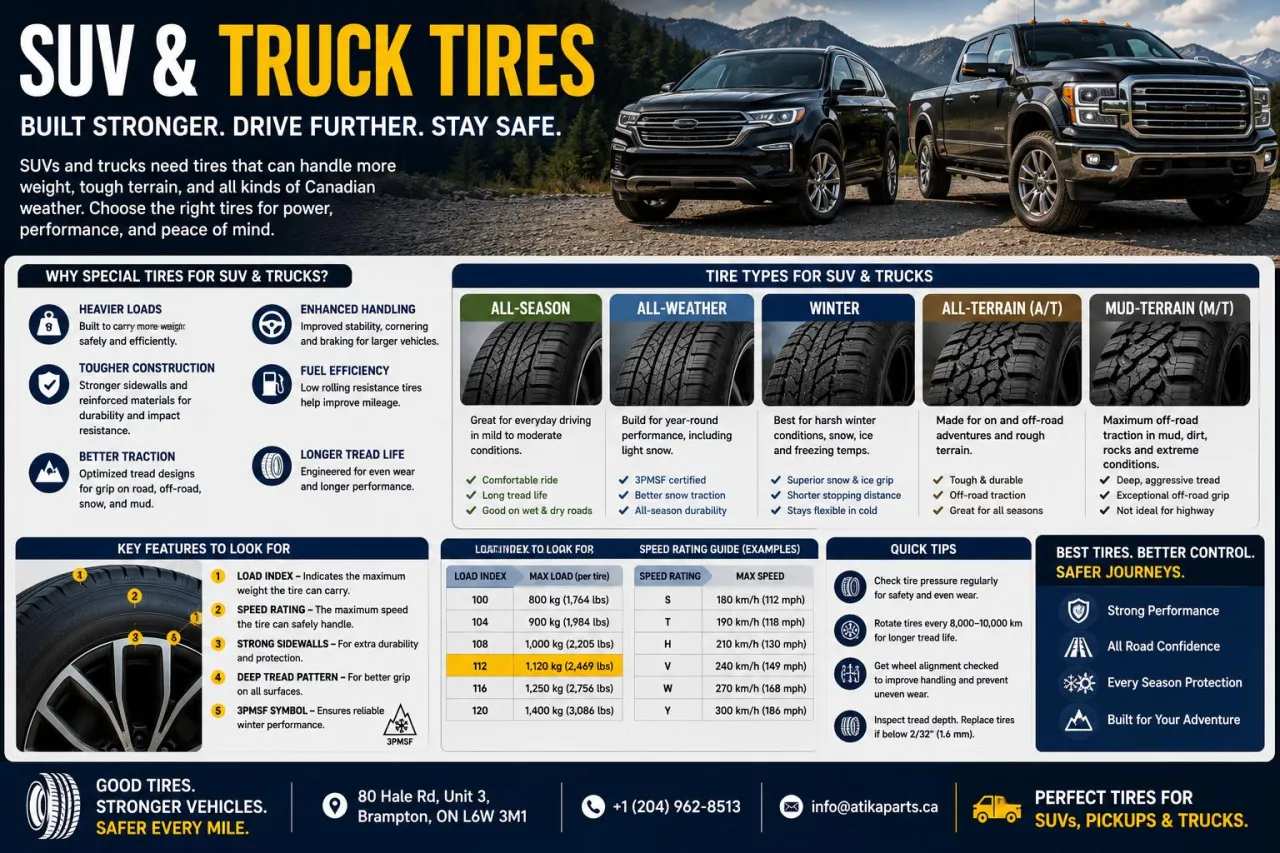
Shopping for the best tires for your SUV or truck is a very different exercise than picking rubber for a compact car, and here in Brampton and across GTA West the stakes are higher: bigger vehicles carry more weight, tow more, and see everything from packed 400-series highways to slushy side streets and gravel job sites. The right set keeps your family safe, your fuel bills sensible, and your ride quiet — the wrong set wears out fast, drones on the highway, or can't handle the load you actually put on it. This guide walks you through every decision that matters: LT versus P-metric, load range and ply, tread categories, towing and hauling numbers, sizing up or down, and how value brands like HAIDA fit in. By the end you'll know exactly what to ask for when you visit us at 80 Hale Rd, Unit 3, Brampton.
SUVs and Trucks Aren't All the Same — Start With Your Vehicle
The phrase "SUV and truck" covers a huge range, and the ideal tire depends heavily on which end of that range you sit on. A car-based crossover like a RAV4, CR-V or Rogue is essentially a tall hatchback: it wants a comfortable, fuel-efficient touring tire and rarely leaves pavement. A body-on-frame SUV such as a 4Runner, Tahoe or Grand Cherokee is heavier and often used for towing or light trails. A half-ton pickup (F-150, Silverado, RAM 1500) hauls, tows and works. A three-quarter or one-ton truck (F-250/350, 2500/3500) carries serious payload and almost always needs purpose-built truck tires.
Before anything else, note three things about your vehicle: the factory tire size (on the door-jamb placard), whether you tow or haul regularly, and how much time you spend off pavement. Those three answers steer nearly every choice below. If reading the numbers on the sidewall feels like a foreign language, our companion piece on how to read tire size breaks it down digit by digit.
LT vs P-Metric: The Most Important Choice for Truck Owners
Look at the start of your tire size and you'll see either a P (or no letter) or the letters LT. This single distinction changes the tire's entire character.
- P-metric (or Euro-metric, no letter) tires are "passenger" construction. They ride softer, roll more efficiently, run quieter and cost less. Most crossovers and many half-ton trucks come from the factory on P-metric or Euro-metric tires, and for daily driving without heavy loads they are the right call.
- LT (Light Truck) tires use heavier construction with stiffer sidewalls and more plies. They're built to carry higher loads at higher inflation pressures, resist punctures on job sites, and hold up under towing and hauling. The trade-offs are a firmer ride, slightly more road noise, and lower fuel economy.
The rule of thumb: if you regularly tow a trailer, carry heavy payloads, or work your truck, LT tires are worth it — and on heavy-duty three-quarter and one-ton trucks they're essentially mandatory. If your SUV or half-ton mostly commutes and runs errands around Mississauga and Brampton, staying with the factory P-metric or Euro-metric keeps things comfortable and economical. When in doubt, match what the manufacturer put on it, and talk it through with us.
Load Range and Ply Rating: Making Sure the Tire Can Take the Weight
On LT tires you'll see a load range letter — C, D, E and so on — which is the modern version of the old "ply rating." Higher letters mean a stronger casing rated for higher inflation pressure and greater load capacity. A common half-ton might use Load Range C or D, while a heavy-duty hauler often needs Load Range E.
Two important cautions. First, a higher load range is not automatically "better" — over-tired trucks with too-stiff a casing ride harshly and can wear the tread centre if run at the wrong pressure. Second, always meet or exceed your vehicle's requirement, never fall short. Under-rated tires on a truck that tows are a genuine safety hazard. For a deeper look at the numbers that govern how much a tire can safely carry and how fast, see our guide to tire speed rating and load index. When you buy from us we'll confirm the load range matches how you actually use the vehicle, not just what fits.
Tread Categories: All-Season, Highway, All-Terrain, Mud and Winter
This is where "best tires for SUVs" gets personal, because the right tread depends entirely on where and how you drive. Here are the main families for bigger vehicles:
- All-season / touring: The default for crossovers and daily-driven SUVs. Quiet, comfortable, long-wearing and fuel-friendly, with balanced grip in dry, wet and light-snow conditions. Ideal for pavement-focused GTA West driving. Remember, though, that "all-season" is really a three-season tire — see below.
- Highway (H/T) truck tires: Purpose-built for pickups and larger SUVs that live on pavement. They emphasize a smooth, quiet ride, long tread life and good towing manners without the noise of aggressive tread. A great choice if your truck commutes and tows but never sees a trail.
- All-terrain (A/T): The popular middle ground. Chunkier tread bites into gravel, dirt and light mud while remaining civil on the highway. Modern A/Ts are far quieter than the mud tires of old, and many carry a snow rating. The cost is a bit more road noise and slightly lower fuel economy.
- Mud-terrain (M/T): Aggressive, blocky tread for serious off-road and deep mud. On pavement they're loud, thirstier and wear faster, so choose these only if you genuinely go off-road often.
- Winter tires: A dedicated cold-weather compound and tread that transforms a heavy vehicle in Ontario snow and ice. More on this next — and it matters more for SUVs and trucks than most people think.
Why Big Vehicles Still Need Winter Tires in Ontario
A common and dangerous myth is that four-wheel drive or all-wheel drive means you don't need winter tires. AWD helps you accelerate on snow, but it does nothing to help you stop or turn — and a heavy SUV or loaded truck carries far more momentum into a corner or a red light than a small car does. Braking and cornering grip come from the tire compound and tread, which is exactly what a dedicated winter tire delivers.
Once temperatures fall below roughly 7°C, all-season rubber stiffens and loses grip regardless of tread depth. A proper winter tire marked with the three-peak mountain snowflake stays pliable and dramatically shortens stopping distances on cold, snowy and icy roads. For a heavy vehicle in Caledon's back roads or on an icy Halton morning, that difference is measured in metres. If you'd rather not swap twice a year, a modern all-weather tire is a legitimate year-round option — we compare the trade-offs in all-season vs winter tires in Ontario and cover the right changeover time in when to install winter tires.
Towing and Hauling: Match the Load Index, Not Just the Size
If you tow a boat, trailer or camper, or you regularly load the bed, the load index (the number just before the speed-rating letter, e.g. the "121" in LT265/70R17 121S) becomes as important as the tread. Every tire has a maximum load it can safely carry at its rated pressure; multiply across all four (or six, for duallies) and you get your real capacity.
Practical guidance for towing and hauling:
- Never drop below the factory load index. Sizing to a lower-rated tire to save money is a false economy and a safety risk.
- Inflate for the load. Heavier loads need higher pressure — check the load/inflation table for your tire and adjust before a big tow. Our tire pressure guide for Ontario explains how temperature and load shift the right number.
- Consider LT for frequent heavy work. The stiffer sidewalls resist the squirm and heat build-up that come with towing.
- Watch the trailer tires too — they're often the weakest and oldest rubber on the road.
Sizing Up or Down: Plus-Sizing, Fitment and the Gotchas
Many SUV and truck owners want a different look or capability than the factory tires offer — a taller, more aggressive setup, or a smaller "winter-size" wheel to save money on the cold-weather set. Both can be done well, but there are rules.
- Keep the overall diameter close to stock (within roughly 3%). A dramatically bigger tire throws off your speedometer, transmission shift points and, on modern trucks, the electronic stability and tow-assist systems.
- Sizing down for winter — a taller-sidewall tire on a smaller-diameter wheel — is a smart, popular move. It cuts the cost of the winter set, protects wheels from potholes and salt, and the extra sidewall improves snow ride quality. Just keep the overall diameter matched.
- Check clearance and rubbing before going bigger, especially at full steering lock or with suspension flex off-road.
- Mind the load rating when you change size — a different size must still meet or exceed the original load index.
This is exactly the sort of thing worth a five-minute conversation before you buy. We'll confirm the size works for your vehicle and how you drive, so you're not surprised at fitting time.
Noise, Comfort and Fuel vs Off-Road Grip: Finding Your Balance
Every tire choice for a big vehicle is a balance, and there's no single "best" — only the best for you. The more aggressive the tread, the more capability you gain off-road and the more you pay in road noise, ride harshness and fuel economy. A highway tire is whisper-quiet and efficient but useless in deep mud; a mud-terrain is unstoppable off-road but tiresome on a daily Brampton commute.
Be honest about how you actually use the vehicle, not how you imagine using it. Most SUV and truck owners in GTA West spend 95% of their time on pavement, which means a good all-season, highway or a moderate all-terrain tire is the sweet spot — plenty of capability for occasional gravel and cottage roads without the noise and cost of hardcore off-road rubber. If you genuinely wheel every weekend, then and only then does a mud-terrain earn its keep.
Choosing Value Brands: You Don't Have to Overpay
Premium-brand SUV and truck tires are excellent, but they carry a premium price — and for many drivers, a well-made value tire delivers the safety, tread life and comfort they need for a fraction of the cost. That's the philosophy behind the brands we stock. HAIDA tires — including the HAIDA Runspirit, HD668 and HD737 lines — give GTA West drivers brand-new, properly rated rubber at honest, fair prices, with sizes to suit crossovers, pickups and vans.
When you're weighing a value brand, focus on the fundamentals rather than the badge: the correct size, an adequate load index and load range for your use, a suitable tread category, and a proper professional installation with balancing. Get those four right and a value tire will serve you honestly. We give you an unvarnished read on where these tires shine — and where a step up makes sense — in our HAIDA tire review. Whatever you choose, buying brand-new (never used) tires and rotating them on schedule, as covered in our tire maintenance guide, is what actually stretches your dollar.
Frequently Asked Questions
Do I need LT tires for my half-ton pickup?
Not necessarily. If your half-ton mostly commutes and runs light errands, the factory P-metric or Euro-metric tires are comfortable, quieter and more fuel-efficient. Choose LT tires if you regularly tow a trailer, carry heavy payloads, or work the truck on job sites, since their stiffer construction handles the load and heat better.
Does all-wheel drive mean I can skip winter tires?
No. AWD and 4WD help you accelerate on snow, but they do nothing to help you stop or turn — and a heavy SUV or truck carries a lot of momentum. Braking and cornering grip come from the tire, so a dedicated winter tire still makes a major safety difference on cold Ontario roads below 7°C.
What does the load range letter (C, D, E) mean on truck tires?
Load range is the modern version of the old ply rating. A higher letter means a stronger casing rated for higher inflation pressure and greater load capacity. Always meet or exceed your vehicle's required load range, but don't over-tire it either, since too stiff a casing can hurt ride comfort and centre-tread wear.
Can I put bigger tires on my SUV or truck?
Often yes, but keep the overall diameter within roughly 3% of stock so your speedometer, transmission and stability systems stay accurate, and confirm there's no rubbing at full steering lock. Any new size must also meet or exceed the original load index. It's worth checking fitment with us before you buy.
Are HAIDA tires a good choice for an SUV or pickup?
For many GTA West drivers, yes. HAIDA lines like the Runspirit, HD668 and HD737 offer brand-new, properly rated tires at fair prices, with sizes for crossovers, trucks and vans. Focus on getting the right size, load rating and tread category for how you drive, and a good value tire will serve you honestly.
How do I know which tire is right for towing?
Match or exceed your factory load index (the number before the speed-rating letter), inflate to the load/inflation table before a heavy tow, and consider LT tires for frequent hauling. Don't forget the trailer's own tires. If you're unsure, bring your towing details to us and we'll confirm the right spec.
Ready to Fit the Right Tires to Your SUV or Truck?
Whether you drive a crossover, a work pickup or a heavy hauler, the team at Atika Auto Parts will match you with brand-new tires that suit how you actually drive — and fit them the same day. Browse our light-truck tires for LT and load-rated options, or explore dependable all-season tires for your daily-driven SUV. We serve Brampton, Mississauga, Caledon, Halton and Vaughan with honest advice and fair prices on value brands like HAIDA. Call us at +1 (204) 962-8513, visit 80 Hale Rd, Unit 3, Brampton, ON L6W 3M1, or contact us to get the right rubber under your vehicle today.
Sizes mentioned in this guide that we stock: