How to Read Tire Size: Decode Your Sidewall (Full Guide)
Published 03 May 2026 · Atika Auto Parts
Learning how to read tire size is one of the most useful skills a driver in Brampton or anywhere across GTA West can pick up. That jumble of numbers and letters stamped on your sidewall — something like P215/60R16 95H — isn't random. It's a precise code that tells you exactly how wide the tire is, how tall its sidewall stands, how much weight it can carry, how fast it's rated to travel, and how it was built. Once you can decode it, you'll shop smarter, avoid costly mismatches, and know exactly what to ask for. At Atika Auto Parts on Hale Road in Brampton we walk customers through this every day, so here's the complete, plain-English breakdown.
The Main Tire Size Code, Broken Down
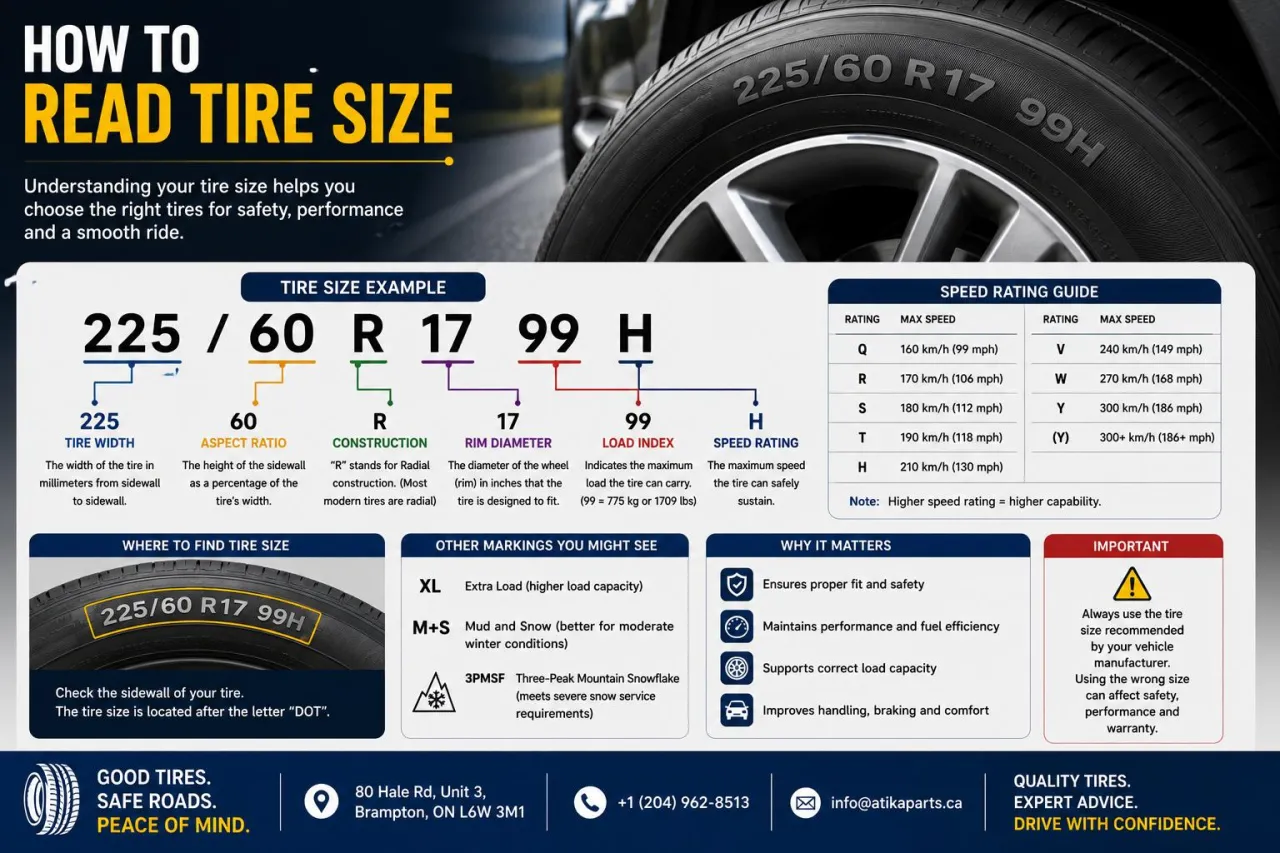
Let's decode a common example: P215/60R16 95H. Every part of that string means something specific, and reading it left to right gives you a full picture of the tire.
- P — Service type. The leading letter tells you the tire's intended use. P stands for "P-metric," meaning a passenger vehicle tire designed to North American standards. If there's no letter at all, it's a "Euro-metric" tire (essentially interchangeable with P-metric in most cases). LT means Light Truck — built with heavier-duty construction for pickups, vans and trailers. You may also see ST (Special Trailer) or T (Temporary spare).
- 215 — Section width. This is the width of the tire in millimetres, measured across the widest point of the tread from sidewall to sidewall. A 215 tire is 215 mm wide.
- 60 — Aspect ratio. This is the sidewall height expressed as a percentage of the width. A 60 means the sidewall height is 60% of 215 mm, or about 129 mm tall. Lower numbers (like 45 or 40) mean a shorter, sportier sidewall; higher numbers mean a taller, more cushioned sidewall.
- R — Construction. R means radial construction, which is what virtually every modern passenger and light-truck tire uses today. You might occasionally see D (diagonal/bias-ply) or B (belted bias) on older or specialty tires.
- 16 — Rim diameter. This is the wheel diameter in inches that the tire is designed to fit. A "16" tire mounts on a 16-inch wheel — and only a 16-inch wheel. This number must match your rim exactly.
So P215/60R16 reads as: a passenger radial tire, 215 mm wide, with a sidewall 60% as tall as it is wide, made to fit a 16-inch rim. The remaining 95H is the service description, which we'll tackle next.
The Service Description: Load Index & Speed Rating
After the size you'll find two more characters — in our example, 95H. Together these are called the service description, and they're just as important as the size itself. The number is the load index and the letter is the speed rating.
The load index is a coded number that corresponds to the maximum weight a single tire can safely carry when properly inflated. It isn't the weight in kilograms directly — it maps to a value on a standardized chart. Here are some common reference points:
- Load index 91 = 615 kg per tire
- Load index 95 = 690 kg per tire
- Load index 99 = 775 kg per tire
- Load index 103 = 875 kg per tire
- Load index 109 = 1,030 kg per tire
The higher the number, the more weight the tire supports. When you replace tires, you should meet or exceed the load index your vehicle was designed for — never go lower, or you risk overloading the tire.
The speed rating letter indicates the maximum speed the tire is engineered to sustain safely. Common ratings include:
- T — up to 190 km/h
- H — up to 210 km/h
- V — up to 240 km/h
- W — up to 270 km/h
- Y — up to 300 km/h
Ontario highway limits mean you'll never legally reach most of these speeds, but the speed rating also reflects the tire's overall stability, heat resistance and handling at speed. As a rule, match or exceed your vehicle's original speed rating so you don't lose performance or handling character. For a deeper dive, see our full guide on tire speed rating and load index.
LT, XL and Other Load-Carrying Markings
Not all tires carry the same reserve strength, and a few extra markings tell you how much load a tire is built to handle. This matters most for SUVs, pickups, vans and anyone who tows or hauls.
- XL or Extra Load — a reinforced passenger tire that can carry more weight at a higher inflation pressure than a standard tire of the same size. Many crossovers and heavier sedans specify XL tires from the factory.
- LT — as noted, a Light Truck tire with stronger casing and higher pressure capacity. LT tires also use a ply rating or load range (for example, Load Range C, D or E) to indicate how much reinforcement they carry.
- SL or Standard Load — the default passenger rating; if you see no XL marking, it's typically SL.
If your truck or SUV came with LT tires, replace them with LT tires — swapping to lighter passenger-rated tires can leave you underrated for towing and hauling. Our guide to the best tires for SUVs and trucks in Ontario covers this in detail, and we stock a full range of brand-new light-truck tires at the shop.
Finding the DOT Date Code (How Old Is Your Tire?)
Every tire sold in North America carries a DOT stamp — a code required by the U.S. Department of Transportation and recognized here in Canada. The important part for most drivers is the four-digit date code at the end of the DOT string, which tells you when the tire was manufactured.
The last four digits read as week and year. For example, "2523" means the tire was built in the 25th week of 2023. A code of "0824" means the 8th week of 2024. This matters because rubber ages even when a tire is barely used — a tire that has sat in storage for years may be near the end of its useful life before it's ever mounted.
When you buy from Atika Auto Parts, you're getting brand-new tires with fresh date codes, not old stock that's been sitting on a shelf. If you're checking a used vehicle or a spare, that DOT date is your first clue to how much life is left. Rubber degrades with heat, sunlight and time, which is one reason we recommend reading our guide on how long tires last in Ontario.
M+S vs 3PMSF: Winter and All-Weather Symbols
Two sidewall markings tell you how a tire is expected to behave in cold and snow, and they are not the same thing — a distinction that really matters through a Brampton winter.
M+S (or M&S) stands for "Mud and Snow." It describes a tread pattern with certain geometry, but it is a manufacturer's self-declaration with no cold-weather performance testing behind it. Most all-season tires carry M+S, yet their rubber stiffens badly in the deep cold and they aren't a true winter solution.
The 3PMSF symbol — the three-peak mountain snowflake — is the one that counts. A tire can only display it after passing a standardized snow-traction test. You'll find 3PMSF on dedicated winter tires and on all-weather tires, which are designed to be run year-round while still meeting the winter-traction standard. If you want to understand the trade-offs, our comparisons of all-season vs winter tires and all-weather vs all-season tires lay it all out for Ontario conditions.
- All-season tire: usually M+S only — fine for spring through fall, not built for hard winter.
- All-weather tire: carries the 3PMSF snowflake — a genuine year-round option for milder GTA winters.
- Winter tire: carries 3PMSF plus soft cold-weather compounds — the best grip on snow and ice.
UTQG: Treadwear, Traction & Temperature
On many passenger tires you'll spot three more ratings grouped under the UTQG (Uniform Tire Quality Grading) system. These help you compare tires of the same type against one another.
- Treadwear — a relative number (like 400, 500 or 640). A higher number generally suggests a longer-wearing tread compound. It's a comparative index within a manufacturer's own line rather than a promise of exact mileage, but it's a useful signal.
- Traction — graded AA, A, B or C (AA is the highest). This measures straight-line wet braking grip on standardized surfaces.
- Temperature — graded A, B or C, reflecting the tire's resistance to heat build-up at speed. A is the most heat-resistant.
UTQG is handy when you're weighing two similar tires and want a longer-lasting, grippier option. It doesn't apply to winter tires and some light-truck tires, so don't be surprised if those markings are absent on your snow set. To get the most life out of whatever you choose, pair smart shopping with our tire maintenance guide.
Where to Find Your Correct Tire Size
You have several reliable places to confirm the size your vehicle actually needs — and reading the current tire is only one of them.
- The driver's door jamb. Open the driver's door and look at the frame or the edge of the door itself. Most vehicles have a tire placard here listing the factory tire size and the recommended cold inflation pressure. This is the gold standard because it reflects what the automaker specified.
- The owner's manual. The manual lists factory tire and wheel specifications, often including optional sizes for different trims.
- The current tire sidewall. Reading the size stamped on the tires already on the car works — but only if a previous owner didn't fit the wrong size. When in doubt, trust the door jamb.
- Inside the fuel door or glovebox. Some manufacturers place the placard here instead.
The placard also lists the correct tire pressure, which drifts with our big Brampton temperature swings — every 10°C drop can cost you noticeable PSI. Keep it dialled in with our tire pressure guide for Ontario.
How to Match a Replacement Tire
Once you can read the sidewall, matching a replacement is straightforward. Follow these rules and you'll never end up with the wrong fit.
- Match the full size exactly. Width, aspect ratio and rim diameter should all match your vehicle's specification (for example, stay with 215/60R16). Changing size changes your speedometer accuracy, handling and clearance.
- Meet or exceed the load index. Never fit a tire rated to carry less than the factory spec, especially on SUVs, vans and trucks.
- Match or exceed the speed rating to preserve handling and heat resistance.
- Keep the same type across an axle — ideally all four. Mixing winter and all-season, or two very different tread types, upsets balance and braking. Replacing in sets of four is best; if you must do two, put the newer pair on the rear.
- Pick the right category for the season. All-season, all-weather or winter — choose based on how you drive through the GTA West year.
If any of this feels like a lot to juggle, that's exactly what our team is for. Bring your vehicle to the shop, or read your door-jamb size to us over the phone, and we'll match a brand-new tire to your exact needs — then handle expert same-day fitting. For budget-conscious drivers, our honest take on HAIDA value tires is worth a read.
Frequently Asked Questions
What does the number 60 mean in a tire size like 215/60R16?
The 60 is the aspect ratio — it's the sidewall height expressed as a percentage of the tire's width. In a 215/60R16 tire, the sidewall is 60% of 215 mm, roughly 129 mm tall. A lower number means a shorter, sportier sidewall.
Is the tire width measured in inches or millimetres?
The width (the first three-digit number, like 215) is measured in millimetres across the widest point of the tread. The last number in the size, the rim diameter, is measured in inches instead.
How do I find the manufacturing date of my tire?
Look for the DOT code on the sidewall and read the last four digits. They represent the week and year of manufacture — for example, "2523" means the 25th week of 2023. At Atika Auto Parts you get brand-new tires with fresh date codes.
What is the difference between M+S and the 3PMSF snowflake?
M+S (Mud and Snow) is a self-declared tread description with no cold-weather testing behind it. The 3PMSF three-peak mountain snowflake is earned by passing a snow-traction test, so it's the marking to trust for genuine winter and all-weather performance.
Can I fit a tire with a different load index or speed rating?
You should always meet or exceed the factory load index and speed rating. Going lower on load can overload the tire, and going lower on speed rating can reduce handling and heat resistance. Matching or exceeding both is the safe choice.
Where is the best place to confirm my correct tire size?
The driver's door jamb placard is the most reliable source, since it lists the size the automaker specified along with the recommended tire pressure. Your owner's manual is a good backup. If unsure, call us in Brampton and we'll confirm it for you.
Ready for the Right Brand-New Tires? We'll Match Your Size
Now that you can read your sidewall, let us fit it. At Atika Auto Parts we carry brand-new tires in every size, category and load rating — including great-value all-season tires and winter tires built for GTA West roads — all backed by expert same-day fitting at honest, fair prices. Just read us the size from your door jamb and we'll take it from there. Call +1 (204) 962-8513, visit us at 80 Hale Rd, Unit 3, Brampton, ON L6W 3M1, or contact us to book your fitting today. We proudly serve Brampton, Mississauga, Caledon, Halton and Vaughan.
Sizes mentioned in this guide that we stock: