Tire Speed Rating & Load Index Explained (Full Guide)
Published 08 Jun 2026 · Atika Auto Parts
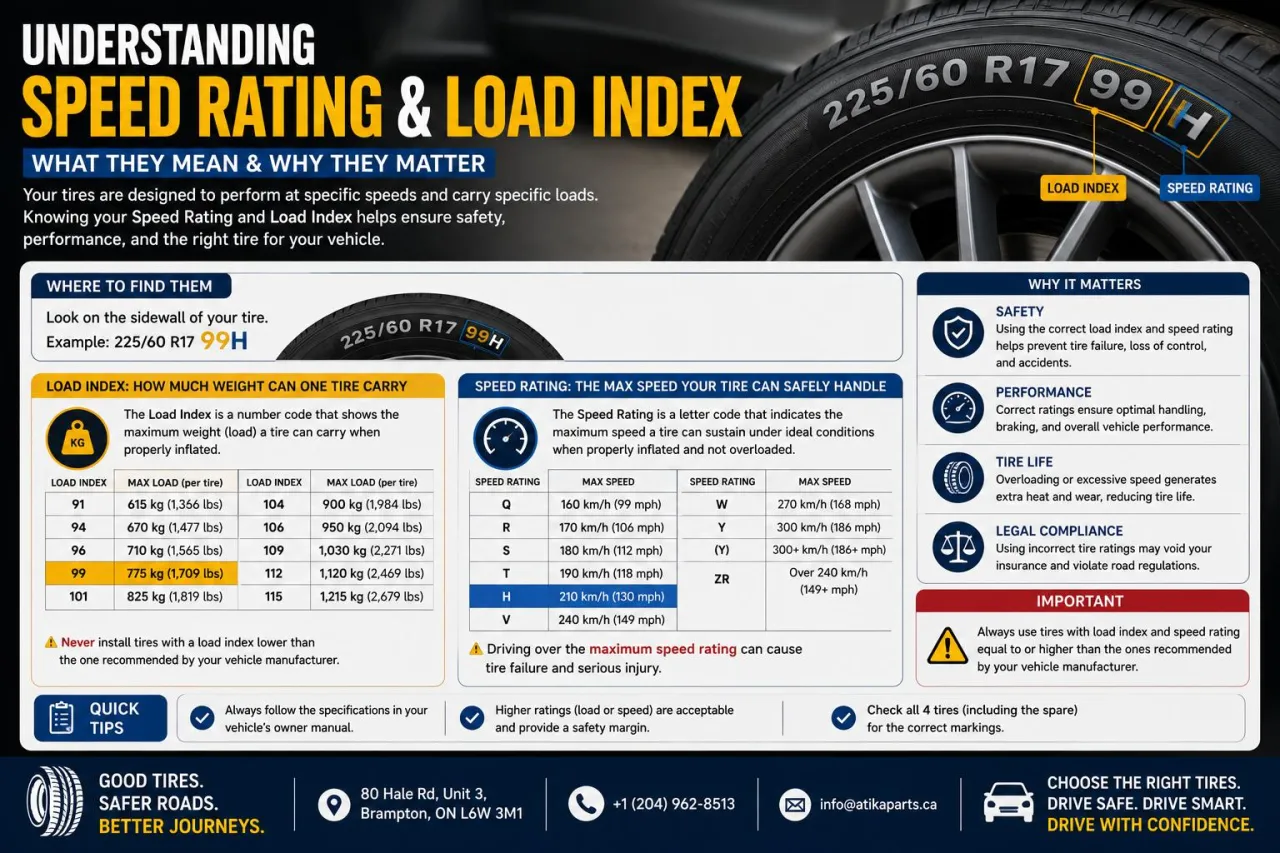
Understanding your tire speed rating and load index is one of the most useful things you can learn as a driver, and it takes only a few minutes. These two little markings on your sidewall — a number followed by a letter, like 91V or 104T — quietly control how much weight your tires can safely carry and how fast they are engineered to run. Whether you are commuting on Highway 410, hauling gear through Caledon, or running errands around Brampton and the rest of GTA West, choosing tires that meet or exceed your vehicle's original ratings keeps your handling, braking, and safety margins where the manufacturer intended them. In this guide we will walk through the full speed-rating letter table, the load-index number-to-kilogram table, why matching your OEM specification matters, the real risks of mixing ratings, what XL and reinforced tires mean, and exactly where to find the rating your vehicle requires.
What the Numbers and Letters on Your Tire Actually Mean
Look at the sidewall of any tire and you will find a service description at the end of the size code — for example, 225/65R17 102H. The size (225/65R17) tells you the width, profile, and wheel diameter. The two characters after it are the ones we care about here. The number (102) is the load index, a coded value for the maximum weight one tire can support. The letter (H) is the speed rating, a coded value for the maximum sustained speed the tire is designed to handle when properly inflated and loaded. Together these form the service description, and both parts are set by your vehicle manufacturer for a reason: they balance grip, heat resistance, ride comfort, tread life, and safety for your specific car. If you want a full breakdown of every character in the size code, our companion guide on how to read your tire size pairs perfectly with this article.
The Complete Speed Rating Chart (Q Through Y)
Speed ratings run through a letter scale, and confusingly the order is almost alphabetical — H sits between U and V for historical reasons. Each letter corresponds to a maximum speed the tire was tested and certified to sustain. Here is the practical range you will encounter on passenger cars, SUVs, and light trucks in Ontario:
- Q — up to 160 km/h (common on winter tires and some light-truck tires)
- R — up to 170 km/h (light-truck and heavier-duty applications)
- S — up to 180 km/h
- T — up to 190 km/h (very common on family sedans and crossovers)
- U — up to 200 km/h
- H — up to 210 km/h (a popular all-season rating for touring tires)
- V — up to 240 km/h (sportier sedans and performance crossovers)
- W — up to 270 km/h (performance and sports vehicles)
- Y — up to 300 km/h (high-performance vehicles)
You may also see (Y) in parentheses, which indicates a tire rated above 300 km/h. It is important to understand what these numbers really represent. A speed rating is not an invitation to drive that fast — Ontario speed limits obviously apply. What the rating actually reflects is the tire's ability to dissipate heat and stay stable under sustained load. A higher-rated tire is engineered with stiffer construction and often stickier compounds, which typically means sharper steering response and shorter braking distances, even at legal highway speeds. That is why the rating matters far more for everyday safety and handling than for outright top speed.
The Load Index Chart: Turning the Number Into Kilograms
The load index is a coded number, not a direct weight, so you need a chart to translate it. Each index value maps to a maximum load per tire. Here are the values you are most likely to see on cars, SUVs, and light trucks around GTA West:
- 85 = 515 kg
- 88 = 560 kg
- 91 = 615 kg
- 94 = 670 kg
- 95 = 690 kg
- 97 = 730 kg
- 100 = 800 kg
- 102 = 850 kg
- 104 = 900 kg
- 108 = 1000 kg
- 112 = 1120 kg
- 116 = 1250 kg
- 121 = 1450 kg
To find your vehicle's total supported weight, multiply a single tire's rating by four. For example, a tire rated 102 (850 kg) gives roughly 3,400 kg of combined capacity across all four corners — comfortably above the loaded weight of most crossovers. This is where load index becomes a genuine safety issue: an under-rated tire runs hotter, flexes more, and is far more prone to failure when you load the vehicle with passengers, luggage, or a full bed of materials. If you drive a pickup or a large SUV, our guide to the best tires for SUVs and trucks in Ontario digs deeper into matching capacity to real-world hauling.
Why Matching or Exceeding Your OEM Rating Matters
Your vehicle manufacturer selected a specific speed rating and load index during engineering, testing the whole system — suspension, brakes, stability control — around those tires. When you replace tires, the safe rule is simple: meet or exceed the original ratings, never go below them. Here is why this matters on three fronts:
- Safety. A lower load index can be overwhelmed when the vehicle is fully loaded, and a lower speed rating means less heat tolerance and reduced high-speed stability. Both erode your margin of safety, especially on long highway runs in summer heat.
- Handling. Speed rating correlates with sidewall stiffness and construction. Dropping to a softer, lower-rated tire can make steering feel vague and lengthen braking distances, changing the way your car behaves in an emergency manoeuvre.
- Warranty and compliance. Fitting tires below the manufacturer's specified ratings can conflict with your vehicle's requirements and may affect warranty considerations. Staying at or above spec keeps you on solid ground.
Going higher than the original rating is generally fine and often beneficial — you gain capability without downside. Going lower is the mistake to avoid. When you buy from us, we always cross-check the rating on your brand-new tires against your vehicle's placard before we fit them.
The Real Risks of Mixing Speed Ratings and Load Indexes
It can be tempting to buy two tires now and two later, or to accept a slightly different rating because the price is right. This is worth thinking through carefully. If you must run different ratings temporarily, the safe practice is that the overall vehicle capability is limited by the lowest-rated tire on the car — your effective speed rating drops to that lowest tire, and your load capacity is governed by the weakest corner. Beyond the numbers, mixing ratings can create subtle handling imbalances, because tires with different construction respond differently to steering and braking inputs.
Our strong recommendation is to replace all four tires with the same size, load index, and speed rating whenever possible. If budget only allows two, fit the matching pair on the rear axle for stability, and plan to complete the set soon. For a deeper look at when it makes sense to replace in pairs versus all four, and how to get the most life out of your set, see our tire maintenance guide.
XL, Reinforced, and Extra Load Tires Explained
You will sometimes see XL, Extra Load, or Reinforced (RF) printed on a sidewall. These markings mean the tire uses a stronger internal construction that lets it carry more weight at a higher inflation pressure than a standard tire of the same size. For the same size code, an XL tire will typically show a higher load index than its standard counterpart. Many modern crossovers, SUVs, EVs, and heavier vehicles come from the factory requiring XL tires precisely because they weigh more — battery packs and larger bodies add mass.
The key point: if your vehicle originally came with XL or reinforced tires, you must replace them with tires that meet that same higher load requirement. Fitting a standard-load tire in place of an XL one drops your capacity and is exactly the kind of downgrade to avoid. XL tires generally call for slightly higher inflation pressures to deliver their rated capacity, so always follow the pressure figures on your door placard — our Ontario tire pressure guide explains how to keep them dialled in through our temperature swings.
How to Find the Speed Rating and Load Index Your Vehicle Requires
You never have to guess. There are three reliable places to find your required ratings:
- The driver's door jamb placard. Open the driver's door and look at the frame or the edge of the door. You will find a sticker listing the original tire size, recommended inflation pressures, and often the load and speed specification. This is the manufacturer's official recommendation for your car.
- The owner's manual. The tire and loading section lists the original equipment specification, including size and service description.
- Your current tires (with caution). Reading the sidewall of the tires already on your car works only if a previous owner or shop fitted the correct ones. If in doubt, trust the door placard over whatever happens to be mounted.
Once you know your target numbers, choosing replacements is straightforward: match the size, then meet or exceed both the load index and the speed rating. Not sure how to interpret what you find? Bring your vehicle to us at 80 Hale Rd, Unit 3, Brampton and we will read the placard with you, confirm the right rating, and recommend a suitable brand-new tire. If you are weighing seasonal options while you are at it, our comparison of all-season versus winter tires in Ontario is a helpful next read.
Where HAIDA Value Tires Fit In
Meeting your required speed rating and load index does not mean you have to overspend. Value brands like HAIDA — including popular lines such as the HAIDA Runspirit, HD668, and HD737 — are engineered to proper load and speed specifications while offering great value for everyday driving around GTA West. The important thing is not the badge on the sidewall but whether the tire matches or exceeds the ratings your vehicle needs. A correctly rated value tire, properly fitted and maintained, is a smart, honest choice for many Brampton drivers. If you would like an independent perspective, our HAIDA tire review covers who these tires suit best and why.
Frequently Asked Questions
Can I use a tire with a higher speed rating than my car needs?
Yes. Fitting a tire with a higher speed rating than your vehicle's original specification is safe and often improves handling and braking response. The rule is to meet or exceed your original rating — never go below it.
Is it safe to use a lower load index tire if I never carry heavy loads?
No, we do not recommend it. Your vehicle's load index is set for its fully loaded weight, and an under-rated tire runs hotter and flexes more, raising the risk of failure. Always match or exceed the original load index printed on your door placard.
What happens if I mix tires with different speed ratings?
The vehicle's effective capability drops to the lowest-rated tire fitted, and mismatched construction can create subtle handling imbalances. Whenever possible, replace all four tires with the same size, load index, and speed rating. If you must fit only two, put the matching pair on the rear axle.
Do winter tires have a lower speed rating?
Often yes. Many winter tires carry a Q or similar rating because they prioritise cold-weather grip over high-speed capability. This is normal and appropriate for Ontario winters, provided the load index still meets your vehicle's requirement.
What does XL or Reinforced mean on my tire?
XL, Extra Load, and Reinforced all indicate a stronger tire that carries more weight at a higher inflation pressure. If your vehicle came with XL tires from the factory, you must replace them with XL-rated tires to keep the same load capacity.
Where do I find the correct rating for my vehicle?
Check the placard on the driver's door jamb, which lists your original tire size, load and speed specification, and recommended pressures. Your owner's manual has the same information. If you are unsure, visit us at 80 Hale Rd, Unit 3, Brampton and we will confirm it for you.
Get the Right Tires, Correctly Rated and Same-Day Fitted
Matching your speed rating and load index is not complicated once you know what to look for — and you do not have to do it alone. At Atika Auto Parts we stock brand-new tires across every category, including all-season tires, winter tires, and light-truck tires, all correctly rated for your vehicle and fitted the same day by experts. We will read your door placard, confirm the exact rating you need, and get you set up at honest, fair prices. Call us at +1 (204) 962-8513, visit us at 80 Hale Rd, Unit 3, Brampton, ON L6W 3M1, or reach out through our contact us page. Whether you are in Brampton, Mississauga, Caledon, Halton, or Vaughan, we are here to keep GTA West rolling safely on the right tires.
Sizes mentioned in this guide that we stock: