
Tire Rotation Guide: Why, When & How (Every Pattern)
Published 02 Jun 2026 · Atika Auto Parts
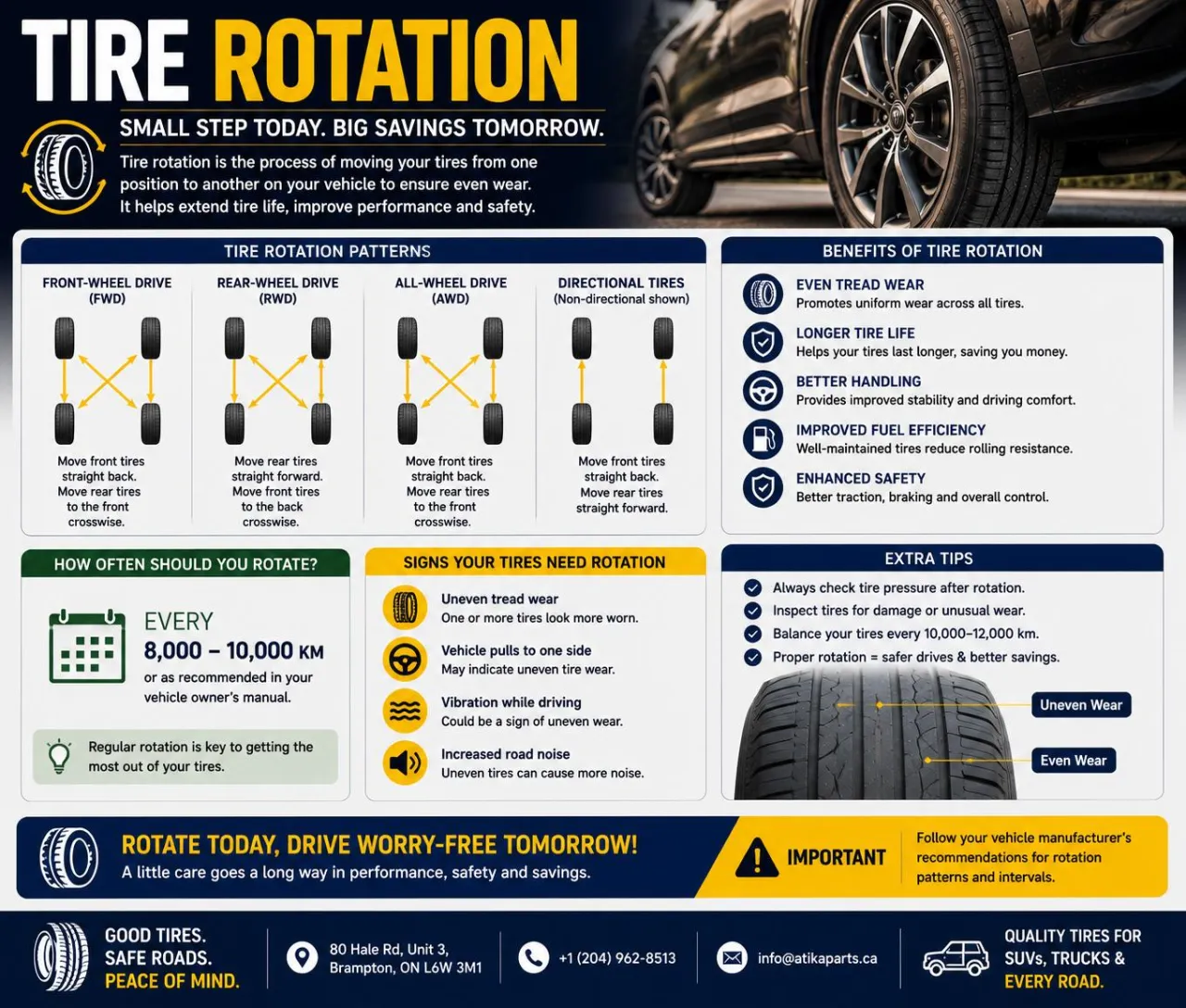
Rotating your tires is one of the simplest, most affordable things you can do to make a set of brand-new tires last, and yet it is the maintenance step drivers skip most often. If you commute across Brampton and the wider GTA West — Mississauga, Caledon, Vaughan and Halton — your tires wear unevenly because of how weight sits on your vehicle, how you steer, and how our seasons batter the roads. This complete tire rotation guide explains exactly why rotation matters, how often to do it, every rotation pattern for front-, rear- and all-wheel drive, and how rotation ties into balancing and alignment. By the end you will know whether to book a shop or do it in your own driveway, and how to spot the warning signs that you are already overdue.
Why Tire Rotation Matters
No two positions on your vehicle wear a tire the same way. The tires that both steer and drive the car take the hardest beating, while the others mostly coast along. On a front-wheel-drive car — which covers most sedans and crossovers on Brampton roads — the front tires handle acceleration, the bulk of braking, and every turn you make, so they can wear out roughly twice as fast as the rears. If you never move them, you end up replacing two tires long before the other two are done, then living with a mismatched set that handles unpredictably in the rain and snow.
Rotation solves this by regularly swapping tire positions so wear averages out across all four. The payoff is real and practical:
- Longer tread life. Even wear means all four tires reach the wear bars at about the same time, so you get the full mileage you paid for.
- Safer handling and grip. Matched tread depths keep braking, cornering and hydroplaning resistance balanced — critical on wet 400-series highways.
- A quieter, smoother ride. Uneven wear patterns like cupping and feathering create hum and vibration that rotation helps prevent.
- Warranty protection. Many tire treadwear warranties require documented rotations at set intervals — skip them and you may void your coverage.
Think of rotation as spreading the workload fairly. It costs very little, and it directly protects the money you spent on a set of brand-new tires.
How Often Should You Rotate Your Tires?
For most vehicles, the sweet spot is every 8,000 to 10,000 km, which for a typical GTA commuter lines up neatly with your oil-change visits. Doing both together is the easiest way to never forget. If your manufacturer's handbook gives a specific figure, follow it — some performance and AWD vehicles ask for tighter intervals.
Here in Ontario there is a bonus reason to keep to that schedule: the seasonal tire changeover. If you swap to a dedicated winter set in late fall and back to summer or all-season tires in spring, each changeover is a natural rotation opportunity. Ask your installer to move the tires to fresh positions as they go back on, and you have effectively rotated twice a year at no extra visit. If you run all-season or all-weather tires year-round, you will need to book rotations on their own since you are not swapping sets.
A few situations call for more frequent rotation: heavy highway mileage, towing or hauling with a light truck, aggressive driving, or any vehicle that is especially hard on its front tires. When in doubt, err on the shorter interval — you cannot rotate too often, but you can easily wait too long.
Tire Rotation Patterns Explained
There is no single "correct" way to rotate — the right pattern depends on your drivetrain and whether your tires are directional or the same size at all four corners. Getting the pattern right matters, because moving a tire to the wrong spot can actually make wear worse. Below are the standard patterns recognised across the industry.
Front-Wheel Drive: Forward Cross
For FWD vehicles with non-directional tires that are the same size front and rear, use the forward cross:
- The two front tires move straight back to the same side (left front to left rear, right front to right rear).
- The two rear tires cross to the opposite front corners (left rear to right front, right rear to left front).
This pattern accounts for the fact that FWD fronts wear hardest and need to be moved to the low-stress rear positions, while the rears cross forward to even out any side-to-side wear.
Rear-Wheel & Four-Wheel Drive: Rearward Cross
For RWD and many part-time 4WD trucks and SUVs, use the rearward cross, which is essentially the mirror image:
- The two rear tires move straight forward to the same side.
- The two front tires cross to the opposite rear corners.
Because the rear tires do the driving on these vehicles, this pattern moves them forward to lighter duty while crossing the fronts back.
All-Wheel Drive: X-Pattern
Full-time AWD vehicles — increasingly common across GTA West driveways — drive all four wheels, so wear is spread more evenly but still benefits from crossing. Use the X-pattern (cross pattern): every tire moves diagonally to the opposite corner (left front to right rear, right front to left rear, and both rears cross forward). AWD systems are sensitive to mismatched tread depths, so consistent rotation is especially important — a difference of just a few millimetres can strain the drivetrain.
Directional Tires: Front-to-Back Only
Directional tires have a tread designed to roll one way, marked by an arrow or the word "ROTATION" on the sidewall pointing in the direction of travel. They must stay on the same side of the vehicle, so you can only rotate them front-to-back on the same side — left front swaps with left rear, right front swaps with right rear. Never cross directional tires across the vehicle, because that would run the tread backwards and hurt wet grip, noise and wear. If they must be crossed (for example to inspect a slow leak), the tire has to be dismounted and remounted the correct way round.
Staggered & Different-Size Setups: The Big Caveat
Some performance cars and premium SUVs run a staggered fitment — wider tires on the rear axle than the front. In that case front-to-back rotation is impossible because the tires are not interchangeable. Your only option is side-to-side on the same axle, and only if the tires are non-directional. If your staggered set is also directional, it cannot be rotated at all without dismounting and remounting. For these vehicles, careful monitoring and precise alignment matter even more, and you may simply need to plan on replacing tires by axle.
Signs You Are Overdue for a Rotation
Even with the best intentions, life gets busy and rotation intervals slip. Your tires will tell you when they have been neglected — learn to read the signs before uneven wear becomes permanent:
- Noticeably deeper tread on one axle. Run a quarter across the tread (Canadian trick: insert the coin with the Caribou's nose down — if you can see the tip of the nose, the tread is getting low). A big front-to-rear difference means you are overdue.
- A hum or growl that grows with speed. Uneven or cupped wear creates a distinctive drone, often mistaken for a wheel bearing.
- Vibration through the steering wheel or seat. This can signal uneven wear, though it may also point to balancing — more on that below.
- Feathered or scalloped tread edges. Run your palm across the tread; if it feels smooth one way and sharp the other, the tire is feathering.
- The car pulling or wandering. Mismatched grip front-to-rear can make the vehicle feel unsettled, especially in the rain.
If you spot any of these, book an inspection sooner rather than later. Catching it early may still let rotation even things out; leave it too long and the damage is baked in. For a deeper dive into wear and lifespan, see our guide on how long tires last in Ontario.
DIY Rotation vs. Booking a Shop
Rotating tires at home is achievable if you are comfortable and properly equipped. You will need a solid floor jack, at least two jack stands (never rely on the jack alone), a torque wrench, and your vehicle's correct lug-nut torque spec. Loosen the lugs while the wheels are still on the ground, lift and support the vehicle safely, follow the correct pattern for your drivetrain, and torque the lugs to spec in a star sequence. Re-check the torque after 50 to 100 km, since fresh wheels can settle.
That said, there are good reasons many GTA West drivers leave it to a shop:
- Safety. Lifting a vehicle incorrectly is genuinely dangerous; a shop hoist removes that risk entirely.
- A proper inspection. A technician checks tread depth, looks for irregular wear, damage and slow leaks, and confirms your tire pressures are correct — things easy to miss at home.
- Correct torque and TPMS. Proper torque prevents warped rotors and loose wheels; a shop can also reset tire-pressure sensors if needed.
- Speed and value. With the right equipment it is quick, affordable, and often bundled with other service.
At Atika Auto Parts in Brampton, rotation is fast, fairly priced, and paired with a genuine look at your tires' health — a small habit that pays off over the life of your set.
How Rotation Ties Into Balancing & Alignment
Rotation is one leg of a three-part stool. To keep tires wearing evenly and your ride smooth, it works hand-in-hand with balancing and alignment — and it is worth knowing what each one actually does.
Balancing corrects tiny weight differences around a tire-and-wheel assembly using small weights on the rim. When a wheel is out of balance, you feel a vibration — usually in the steering wheel at highway speed. Balancing is done whenever a tire is first mounted, and it is smart to re-check balance if you notice new vibration or when you rotate. If your steering shimmies at a specific speed, balancing is the usual culprit, not rotation.
Wheel alignment sets the angles at which your tires meet the road — toe, camber and caster. Ontario's potholes and curbs knock these angles out of spec, and poor alignment causes rapid, uneven wear (a tire scrubbed bald on one edge is the classic tell) plus pulling to one side. Alignment is a separate service from rotation, but they are natural partners: there is little point rotating tires onto a vehicle that is chewing them up because the alignment is off.
A simple rule of thumb: rotate on schedule to even out wear, balance when you feel vibration or mount new tires, and get an alignment checked at least once a year, after hitting a serious pothole, or whenever you notice pulling or edge wear. Together, these three habits — alongside correct pressures and good driving — are the heart of a solid tire maintenance routine.
Frequently Asked Questions
How often should I rotate my tires?
For most vehicles, every 8,000 to 10,000 km — which conveniently lines up with a typical oil change. In Ontario, your twice-yearly winter and summer tire changeovers are also natural rotation opportunities. Always follow your owner's manual if it specifies a different interval.
What is the correct rotation pattern for my car?
It depends on your drivetrain. Front-wheel drive uses a forward cross, rear- and four-wheel drive use a rearward cross, and all-wheel drive uses an X-pattern where every tire moves diagonally. Directional tires can only be rotated front-to-back on the same side.
Can I rotate directional or staggered tires?
Directional tires must stay on the same side and rotate front-to-back only, since crossing them would run the tread backwards. Staggered setups with different front and rear sizes can only be swapped side-to-side on the same axle, and if they are also directional they cannot be rotated without dismounting and remounting.
Is tire rotation the same as balancing or alignment?
No. Rotation moves tires to new positions to even out wear. Balancing corrects weight imbalances that cause vibration. Alignment adjusts the angles your tires sit at to prevent uneven wear and pulling. They are separate services that work together, and it is common to check balance during a rotation.
What happens if I never rotate my tires?
The tires that both steer and drive your vehicle wear out much faster than the others, so you replace two tires early and end up with a mismatched set. You also risk cupping, feathering, more road noise, poorer wet grip, and voiding any treadwear warranty that requires documented rotations.
Can I get my tires rotated in Brampton at Atika Auto Parts?
Yes. We offer fast, fairly priced tire rotation at 80 Hale Rd, Unit 3 in Brampton, and we serve drivers across Mississauga, Caledon, Vaughan and Halton. Every rotation includes a proper tread and pressure inspection, and we can pair it with balancing or your seasonal changeover. Call +1 (204) 962-8513 to book.
Keep Your New Tires Rolling Longer — Visit Atika Auto Parts
Regular rotation is the cheapest insurance you can buy for a set of tires — but it only pays off if you start with quality rubber and keep it in good shape. When it is time for a fresh set, explore our range of brand-new tires, including dependable all-season tires for year-round GTA driving and dedicated winter tires for Ontario's toughest months. We stock great-value brands like HAIDA and offer expert same-day fitting, honest advice, and rotation, balancing and changeover services all under one roof.
Drop by 80 Hale Rd, Unit 3, Brampton, ON L6W 3M1, call us at +1 (204) 962-8513, or reach out through our contact us page to book your rotation or shop new tires. Proudly serving Brampton, Mississauga, Caledon, Vaughan and Halton — drive on tires that last.