
How Ontario Potholes Damage Tires & Wheels (What to Do)
Published 06 Jul 2026 · Atika Auto Parts
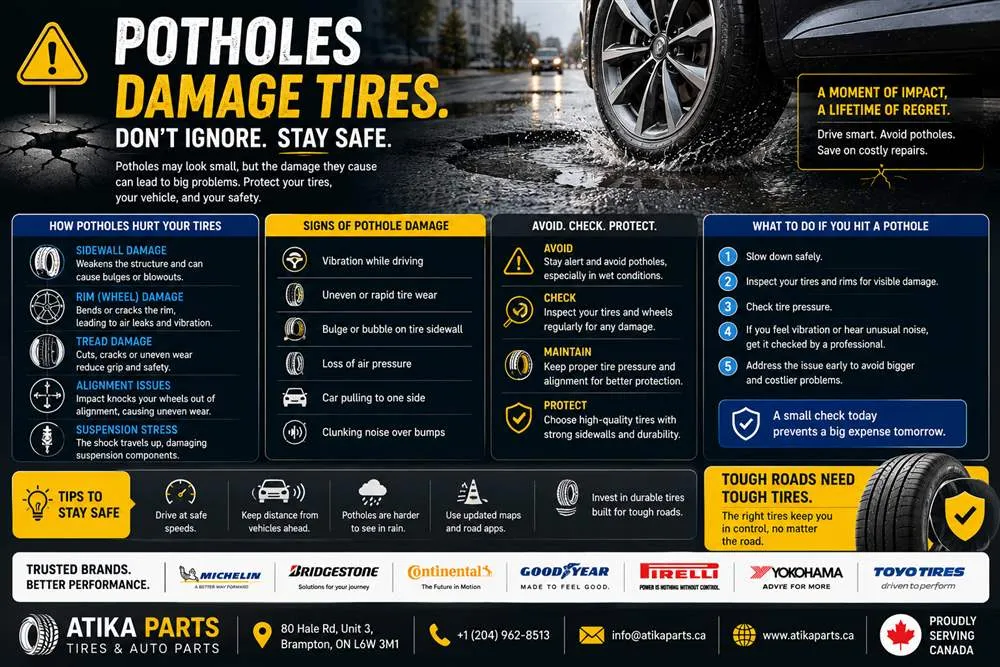
If you drive anywhere across the GTA West, you already know the feeling: that jarring thud when a tire drops into a pothole you never saw coming. Pothole tire damage in Ontario spikes every spring as the freeze-and-thaw cycle chews up roads from Brampton to Mississauga, and the results can range from a slow leak to a bent rim. Here at Atika Auto Parts on Hale Road in Brampton, we see the aftermath every March and April — so here is a plain-English guide to what potholes do, what to do right after you hit one, and how to lower your risk.
Why Ontario Roads Turn Into Pothole Season Every Spring
Potholes are born from water and cold. Moisture seeps into small cracks in the pavement, freezes and expands overnight, then melts during the day. Repeat that cycle through an Ontario winter and the road surface weakens until traffic punches a hole through it. By the time the snow clears, arterial roads and highway ramps around the 401 and 407 are dotted with craters.
The GTA West gets hit especially hard because of heavy commuter traffic and big temperature swings. Whether you are heading through Brampton, Caledon, Halton, or Vaughan, spring is simply the season when your tires and wheels take the most abuse — often at highway speed, where the impact is worst.
How a Pothole Actually Damages Your Tires and Wheels
A pothole hit is a sudden, sharp impact that pinches the tire between the road edge and the rim. That single moment can cause several kinds of damage, some obvious and some hidden:
- Sidewall bulges: The impact can break some of the internal cords inside the tire's sidewall. Air then pushes out through the weak spot, creating a visible bubble or bulge. A bulged sidewall cannot be safely repaired — the tire needs replacing.
- Bent or cracked rims: Alloy wheels are strong but not indestructible. A hard edge can bend the rim's lip, break the seal between tire and wheel, or in severe cases crack the metal.
- Slow leaks: A bent rim or a small break in the bead seal often lets air escape gradually. You may not notice until your tire-pressure light comes on days later.
- Alignment and suspension knocks: A big pothole can shove your steering and suspension out of alignment, leading to uneven tire wear and a car that pulls to one side.
- Tread punctures or cuts: Sharp broken pavement at the edge of a pothole can slice the tread outright.
If you are not sure how to read the signs of an alignment problem, our guide on wheel alignment and balancing warning signs walks through the symptoms in detail.
What to Do Right After You Hit a Pothole
The moments after a hard impact matter. Here is a calm, sensible checklist:
- Do not slam the brakes mid-pothole. If you can see it coming, ease off the accelerator before the hit rather than braking hard over it, which can make the impact worse.
- Pull over safely once past it and check your tires. Look for bulges, cuts, or a wheel that suddenly sits low.
- Check for pulling or vibration. If the steering wheel now shakes or the car drifts to one side, note it — that points to alignment or a bent wheel.
- Watch your pressure over the next few days. A slow leak may take time to show up. Top up and monitor, and see our guide on tire pressure in Ontario for the right numbers.
- Handle a flat calmly. If a tire goes down, our post on what to do about a flat tire and how to prevent one covers your safest next steps.
Even if the car seems fine, a hidden bulge or a slightly bent rim can worsen over kilometres. When in doubt, have it looked at — a quick inspection is far cheaper than a highway blowout on the 401.
How to Reduce Your Pothole Risk in the GTA West
You cannot fix Ontario's roads, but you can drive smarter through pothole season:
- Keep your tires properly inflated. Under-inflated tires flex more and offer less protection to the rim on impact. Over-inflated tires ride harder and crack easier. Correct pressure is your best cushion.
- Leave space and slow down over rough patches, especially on unfamiliar roads around Milton, Oakville, and Caledon where the shoulder can hide deep holes.
- Watch for water. A puddle after a spring melt can conceal a surprisingly deep crater — treat standing water as suspect.
- Don't swerve blindly. Jerking into the next lane to dodge a pothole is often more dangerous than the pothole itself. Slow down and hold your line.
- Keep tread and tires healthy. Worn or aging tires are more prone to pothole damage. Fresh, quality rubber like our value-priced all-season tires gives you more margin.
Good habits and a set of sound, brand-new tires go a long way toward getting you through the worst of spring.
Get Your Tires and Wheels Checked at Atika Auto Parts
If you have hit a rough pothole anywhere from Brampton to Vaughan and something feels off — a bulge, a shimmy, a slow leak, or a pull — bring it to us. We carry brand-new tires only, including great-value HAIDA lines, and offer expert same-day fitting so you are back on the road quickly. Explore our full range on the tires page or learn more about what we offer on our services page.
Call us at +1 (204) 962-8513 or drop by 80 Hale Rd, Unit 3, Brampton, ON L6W 3M1. We are proud to serve honest, fair-priced tire care to drivers across Brampton, Mississauga, Caledon, Halton, and Vaughan — the whole GTA West.