
Run-Flat Tires Explained: How They Work & Who Needs Them
Published 06 Jul 2026 · Atika Auto Parts
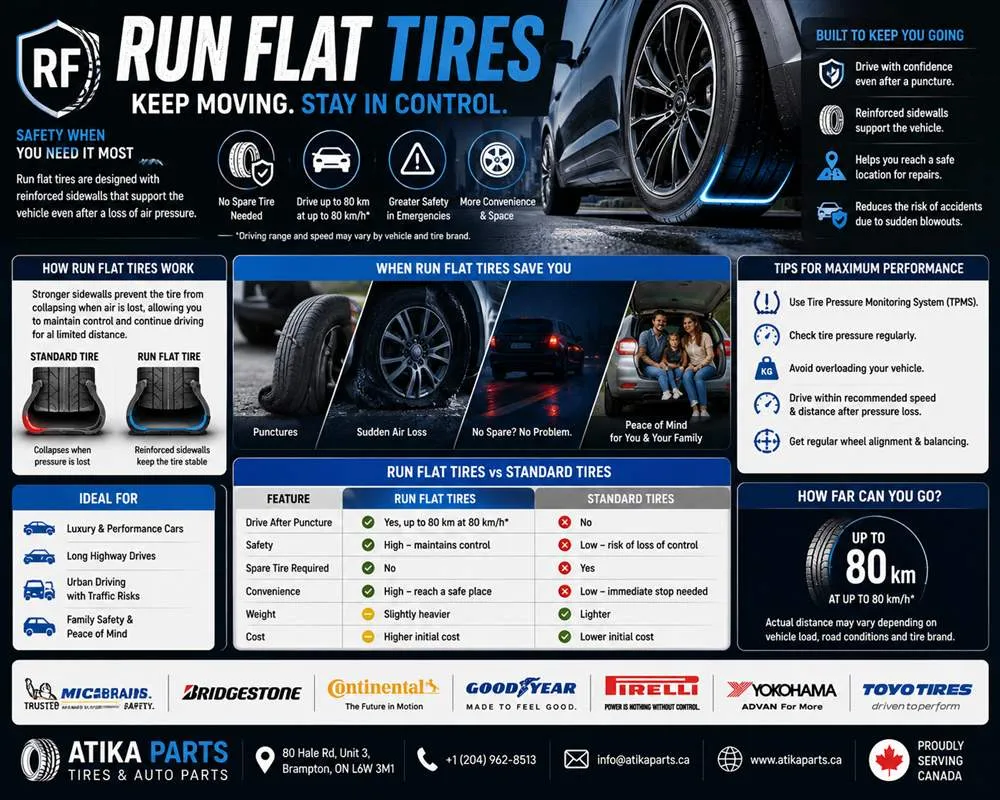
If you have ever heard the term run-flat tires and wondered whether they are worth it, you are not alone. Plenty of drivers here in Brampton and across GTA West ask us about them — especially those who commute daily on the 401 or 407 and dread the thought of a puncture in fast-moving traffic. In this guide we will explain exactly how run-flat tires work, their real pros and cons, and who they actually suit.
What Are Run-Flat Tires?
Run-flat tires are designed to let you keep driving for a short distance after a puncture or sudden loss of air pressure — instead of leaving you stranded on the shoulder. The idea is simple: even with zero air pressure, the tire holds enough shape to carry your vehicle safely to a repair shop or a safer spot to stop.
There are two main types you will come across:
- Self-supporting run-flats: These have reinforced, thicker sidewalls that bear the vehicle's weight when the air is gone. This is by far the most common design.
- Support-ring run-flats: These use a hard rubber or plastic ring inside the wheel that supports the tread when pressure drops. They are far less common on everyday passenger cars.
How Do They Let You Keep Driving?
On a regular tire, the sidewall relies almost entirely on air pressure to stay rigid. Lose that pressure and the sidewall collapses, the tire folds under the rim, and driving further can destroy both the tire and the wheel. Run-flats solve this with those extra-strong sidewalls that hold their shape on their own.
That said, a run-flat is not a magic carpet. After a puncture you typically get around 80 km of driving at a reduced speed — usually about 80 km/h — though the exact figures vary by brand and model. It is enough to get you from, say, a Caledon back road to a shop in Brampton, or from the 407 to the nearest safe exit. It is not a licence to keep driving on it indefinitely.
One important note: because run-flats do not visibly go flat, you may not notice a puncture at all. That is why every vehicle fitted with them relies on a working tire pressure monitoring system (TPMS) to warn you. If you would like a refresher on that, our TPMS, valve & wheel care guide covers it well.
The Pros of Run-Flat Tires
There is a genuine appeal to run-flats, and it comes down to peace of mind:
- No roadside tire change: You avoid crouching beside a busy Ontario highway in the rain or a −15°C winter morning, fumbling with a jack.
- Safer after a sudden blowout: Because the sidewall holds firm, the vehicle stays more stable and controllable when pressure drops suddenly at speed.
- Often no spare tire needed: Many vehicles built for run-flats skip the spare entirely, which frees up trunk space and reduces weight.
- Get to help on your own terms: Rather than waiting for a tow on the shoulder of the 401, you can drive to a shop where it is warm and safe.
The Cons You Should Know About
Run-flats are not the right answer for everyone, and we believe in being straight with our customers. Here are the honest trade-offs:
- Firmer ride: Those stiff sidewalls that make them work also transmit more bumps. On Brampton's pothole-prone spring roads, you will feel the difference.
- Higher cost: Run-flats generally cost more than comparable conventional tires, and there are fewer options to choose from.
- Limited repairability: Many manufacturers advise against repairing a run-flat that has been driven on while flat, because the internal structure may be damaged. That often means replacement rather than a simple patch.
- Not always interchangeable: You generally should not mix run-flats and regular tires, and switching from run-flats to standard tires may mean adding a spare kit.
Who Are Run-Flat Tires Right For?
Run-flats tend to suit drivers who value convenience and safety over ride comfort and cost. You might be a good candidate if:
- Your vehicle came from the factory with run-flats and has no spare tire — in that case, staying with run-flats is often the simplest choice.
- You do a lot of solo highway driving across GTA West and want to avoid roadside changes.
- You are not physically able to change a tire and prefer the reassurance of driving to help.
On the other hand, if you prioritize a smooth ride, want the widest tire selection, or are watching your budget, high-quality conventional tires paired with good habits may serve you better. Knowing what to do when you get a flat tire — and how to prevent one goes a long way, whichever tire you choose. Whatever fits your vehicle and driving, we stock a full range of brand-new tires and can walk you through the options honestly.
Talk to Atika Auto Parts About Your Tires
Not sure whether run-flats or conventional tires are the smarter pick for your car and your commute around Brampton, Mississauga, Caledon, Halton or Vaughan? Come in and talk it through with our team — we will look at your vehicle, your driving, and your budget, then fit brand-new tires the same day at fair, honest prices. Call us at +1 (204) 962-8513 or drop by 80 Hale Rd, Unit 3, Brampton, ON L6W 3M1. You can also contact us here or browse our full tire selection online.