
Spare Tire Types Explained: Donut, Full-Size & Kits
Published 06 Jul 2026 · Atika Auto Parts
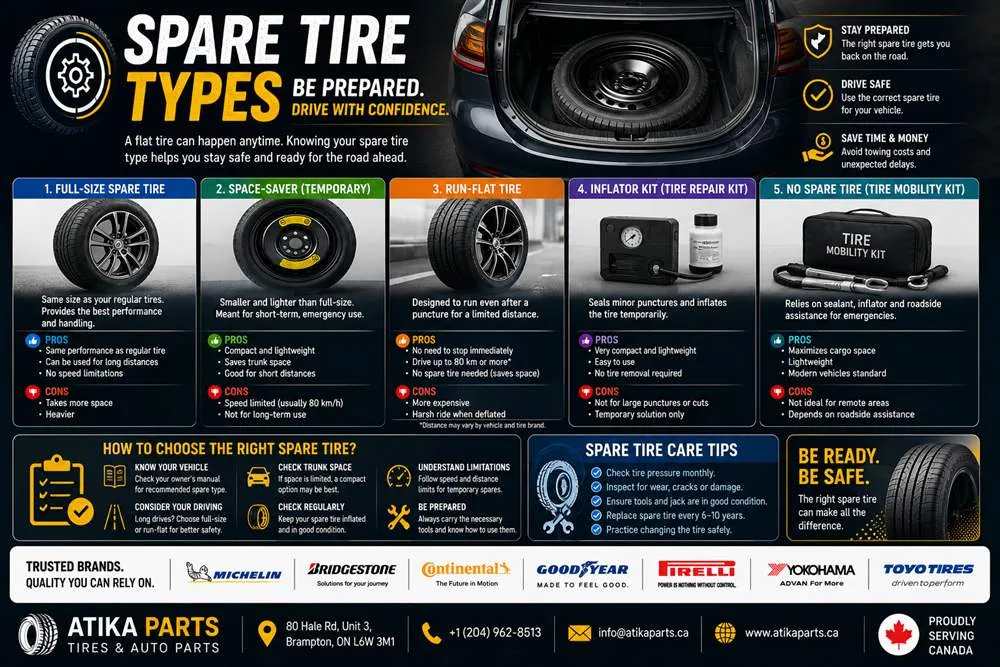
Most drivers never think about their spare tire until the moment a flat leaves them stranded on the shoulder of the 407 or in a busy Brampton plaza. Yet what’s tucked in your trunk — or whether anything is there at all — makes a real difference to how quickly and safely you get moving again. This guide walks GTA West drivers through the main spare tire types, their limits, and how to keep whatever you carry ready for the day you need it.
Why Spare Tires Have Changed Over the Years
A generation ago, nearly every vehicle came with a full-size spare bolted under the trunk floor. Today, automakers juggle fuel economy, cargo space, and weight, so what you actually have on board varies widely. Some newer cars in Mississauga and Vaughan driveways ship with no spare at all — just a repair kit or run-flat tires. Knowing which camp your vehicle falls into is the first step. Pop the trunk, lift the floor panel, or check your owner’s manual before you ever face a roadside emergency.
Full-Size Spare: The Gold Standard
A full-size spare is a complete, matching tire and wheel — the same size as the four already on your vehicle. It’s the most capable option and the one that gets you back to normal driving fastest.
- Pros: No speed or distance restrictions when it matches your other tires. You can drive it indefinitely and even rotate it into regular use.
- Cons: It’s heavy and takes up significant trunk or under-body space. If it sits unused for years, the rubber can age and the pressure can drift low.
- Good to know: If your spare is a different tread or brand than the road tires, treat it as a temporary fix and replace or match it soon — especially important on light trucks and SUVs common across Caledon and Halton.
Compact “Donut” Spare: Light and Limited
The compact temporary spare — universally nicknamed the “donut” — is the most common spare on passenger cars. It’s smaller, narrower, and much lighter than a standard tire, which is exactly why manufacturers favour it.
- Speed limit: Almost every donut is stamped with a maximum of about 80 km/h. Keep it slow, even if traffic on the 401 is flowing faster.
- Distance limit: These are meant for roughly 80 km — enough to reach a shop, not to finish a road trip to cottage country.
- Higher pressure: Donuts often run at around 60 psi, far more than a normal tire. Check the sidewall for the exact figure.
- Handling: Because it’s narrower, the donut reduces grip and can affect braking and stability control — drive gently and avoid hard cornering.
A donut is a get-you-home tool, not a long-term solution. Once it’s on, head straight to a shop to have your damaged tire repaired or replaced.
Run-Flat Tires: No Spare Needed
Some vehicles skip the spare entirely by fitting run-flat tires. These have reinforced sidewalls that support the car’s weight even after a puncture, letting you keep driving on a deflated tire for a limited stretch.
- Typical limit: Most run-flats allow roughly 80 km at speeds up to about 80 km/h after losing pressure — always confirm your specific tire’s rating.
- Pros: No changing a tire on the roadside; more trunk space; you stay mobile after a puncture.
- Cons: They generally can’t be repaired once run flat, tend to cost more, and a working TPMS is essential since you may not feel the pressure loss. See our TPMS, valve & wheel care guide for more.
Tire Repair & Inflator Kits: The Modern Compromise
Increasingly, new cars come with a sealant-and-compressor kit instead of any spare. The kit injects liquid sealant into the tire and reinflates it enough to reach help.
- Best for: Small punctures in the tread from a nail or screw — the everyday flat.
- Won’t help with: Sidewall damage, large gashes, or a blowout — the kind of damage a Brampton pothole can cause.
- Watch the expiry: Sealant has a shelf life, usually a few years. Check the date so you’re not relying on a dried-out cartridge.
- Temporary only: A sealed tire still needs professional inspection soon after — sealant is a bridge to the shop, not a permanent repair.
Don’t Forget to Check Your Spare’s Pressure
A spare is only useful if it’s inflated. Because spares sit unused for months or years, they quietly lose air — and a flat spare is no help at all.
- Find the correct pressure on the spare’s sidewall (donuts are much higher than road tires).
- Check it with a gauge every few months, and always before a long drive toward Oakville, Burlington, or Milton.
- Inspect for cracks, dry rot, or an expiry — rubber ages even when it’s never driven on.
- Confirm your jack, lug wrench, and wheel lock key are all present and accounted for.
Not sure how to respond when a flat actually happens? Our companion post on what to do about a flat tire & how to prevent one covers the step-by-step roadside routine.
Come See Us at Atika Auto Parts
Whether your spare has aged out, your donut got you home and now you need a proper repair, or you’re ready for a fresh set of brand-new tires, we’re here to help GTA West drivers with honest advice and fair prices. Explore our tire selection or learn about our fitting services, then stop by for expert same-day fitting. Call +1 (204) 962-8513 or visit us at 80 Hale Rd, Unit 3, Brampton, ON L6W 3M1 — conveniently placed for Brampton, Mississauga, Caledon, Halton, and Vaughan.