
Tire Warranty Guide: What Ontario Drivers Should Know
Published 06 Jul 2026 · Atika Auto Parts
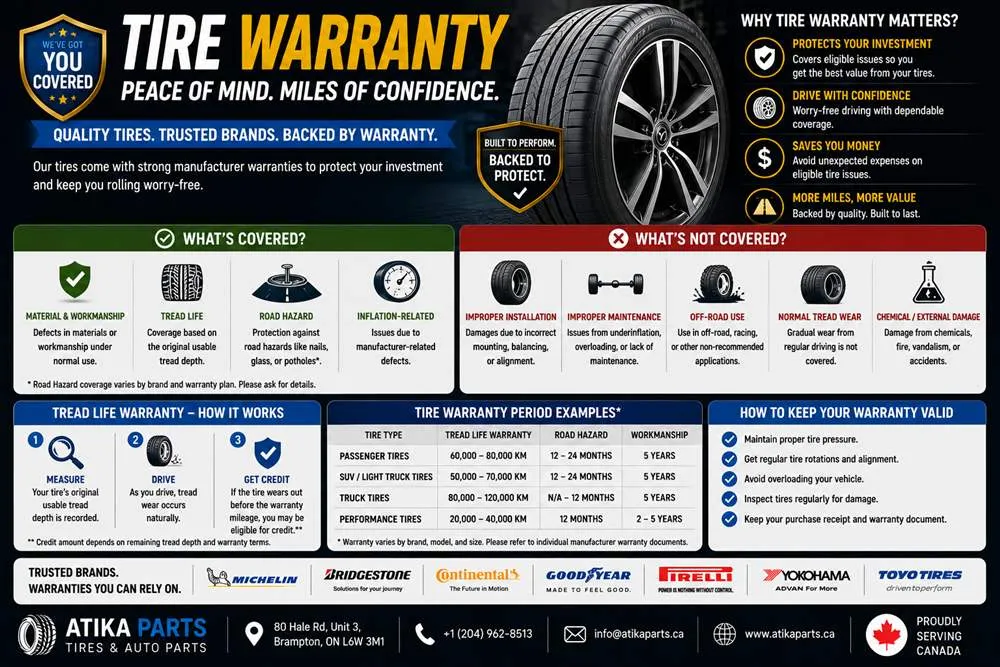
When you buy a set of new tires, you're not just paying for rubber — you're buying a promise about how those tires should perform and how long they should last. Understanding your tire warranty before you drive off the lot can save you real money and frustration down the road, especially with the mix of summer heat, spring potholes and winter slush that Brampton and GTA West drivers deal with every year. This plain-English guide breaks down the main types of tire warranties, what quietly voids them, and why hanging on to your paperwork matters.
Treadwear (Mileage) Warranty
The treadwear warranty is the one most people think of first. A manufacturer estimates how many kilometres a tire should last under normal use — for example, a tire might carry a 60,000 km rating. If the tread wears out early despite proper care, you may be entitled to a prorated credit toward a replacement.
A few things worth knowing:
- It's usually prorated. If a 60,000 km tire wears out at 40,000 km, you don't get a free replacement — you get a credit based on the unused portion.
- Not every tire carries one. Many great-value tires, including winter and some light-truck models, focus on grip and durability rather than a long mileage rating. That's normal and not a red flag.
- Proof of maintenance is required. Manufacturers expect regular rotation and correct inflation, and they may ask for records before honouring a claim.
Manufacturer Defect (Workmanship & Materials) Warranty
This covers the tire itself — the way it was built. If a tire fails because of a fault in workmanship or materials (think separation, bulging or uneven structural issues that aren't from road damage), this warranty steps in. Coverage is typically strongest in the early life of the tire and tapers as the tread wears down.
The important distinction here: a defect warranty covers problems that come from the factory, not damage from the road. A nail in the tread or a sidewall gash from a Brampton pothole is road damage, not a manufacturing defect. If you're ever unsure which category a problem falls into, bring the tire in and let us inspect it — our team fits and diagnoses tires every day and can tell you honestly what we see.
Road-Hazard Coverage
Road-hazard protection is separate from the manufacturer warranties above, and it's the one that speaks directly to Ontario driving. It helps cover damage from everyday hazards — nails, sharp debris, and the potholes that appear along the 401 and 407 corridors every spring. Depending on the plan, it may pay toward a repair or a prorated replacement when a tire is damaged beyond safe repair.
- Road-hazard terms vary widely, so ask exactly what's included and for how long.
- Small punctures in the tread area can often be safely repaired — a repair is usually cheaper than a claim, and we'll always tell you when a plug-and-patch is the right call.
- Sidewall damage generally can't be repaired safely, which is where this coverage earns its keep.
What Quietly Voids a Tire Warranty
Here's where a lot of drivers get caught out. Warranties assume the tire is cared for properly, and neglect can void your coverage even when the tire genuinely failed. The most common culprits:
- Under-inflation. Running low on pressure builds heat, wears the shoulders unevenly and can cause internal damage. Check your pressure monthly — our tire pressure guide for Ontario walks through how.
- Skipping rotations. Manufacturers expect regular rotation to keep wear even. No rotation history is one of the fastest ways to have a treadwear claim declined.
- Poor alignment or worn suspension. Uneven wear from a vehicle problem isn't the tire's fault, and it usually isn't covered.
- Improper repairs. A DIY plug or a repair done outside the tread area can void coverage. Have punctures assessed properly.
- Wrong use. Overloading, racing, or fitting a tire that isn't rated for your vehicle falls outside normal use.
Good habits protect both your tires and your warranty. Our tire maintenance guide covers the simple routine that keeps coverage intact and tread lasting longer.
Keep Your Receipts — They Are Your Warranty
A warranty is only as good as your ability to prove it. Manufacturers and shops need to see that you bought the tires, when, and that you maintained them. Hold on to:
- Your original purchase receipt or invoice, showing the date and tire details.
- Records of rotations, balancing and any repairs.
- Alignment receipts, since alignment protects even wear.
Snap photos of these documents and keep them in your phone as a backup. If a claim ever comes up, having everything ready makes the process far smoother. When you buy from us, we keep your fitting details on file, and we're happy to talk you through the coverage on any set before you commit — that's covered in our how to buy new tires in Ontario guide too.
Talk to Atika Auto Parts About Your Next Set
Warranties shouldn't be fine print you decode alone. At Atika Auto Parts in Brampton, we sell brand-new tires only — all-season, all-weather, winter and light-truck — and we'll explain the coverage on each option in plain language, then fit them the same day. We proudly serve drivers across Brampton, Mississauga, Caledon, Halton and Vaughan.
Ready to buy with confidence? Call us at +1 (204) 962-8513 or visit us at 80 Hale Rd, Unit 3, Brampton, ON L6W 3M1. Browse our full range of tires or get in touch and we'll help you choose a set that fits your vehicle, your driving and your budget.