
Off-Season Tire Storage in Ontario: A Practical Guide
Published 12 Jun 2026 · Atika Auto Parts
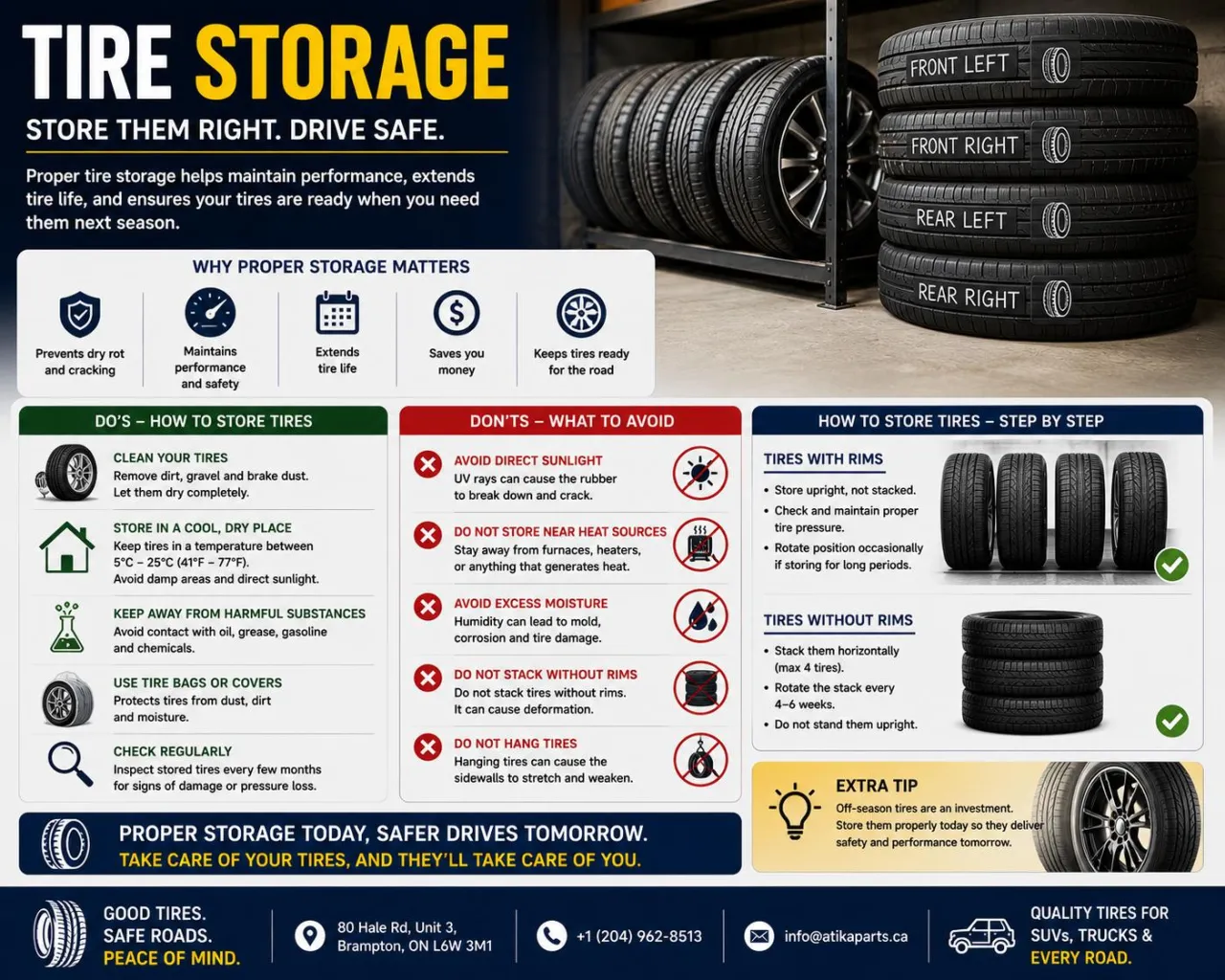
Twice a year, most drivers across the GTA West swap between two sets of rubber — a grippy winter set for the cold months and an all-season or summer set for the warmer ones. What you do with the set that comes off matters just as much as the set going on. Proper off-season tire storage in Ontario protects your investment, and here in Brampton we regularly see tires that could have lasted years longer if they had simply been stored the right way.
Whether you keep your spare set in a Brampton garage, a Mississauga condo locker or a Caledon shed, the same principles apply. Here is how to do it properly.
Why Proper Storage Extends Tire Life
Tires are made from rubber compounds that slowly break down when exposed to heat, sunlight, ozone and moisture. A set of brand-new tires represents a real chunk of your vehicle budget, so treating them well between seasons keeps them safe and roadworthy for longer. Poor storage can cause:
- Dry rot and cracking from sunlight (UV) and ozone exposure.
- Flat spots from sitting under weight in one position for months.
- Corroded rims and rusted TPMS sensors when tires are mounted on wheels and left damp.
- Odours and mildew from moisture trapped against the rubber.
A little care over the off-season pays off in even wear and full tread life once the tires go back on. It works hand in hand with regular upkeep — see our tire maintenance guide for the full picture.
Step 1: Clean and Dry Before Storing
Never store tires with road grime, brake dust or winter road salt still on them — and here in Ontario, salt is everywhere from November through April. Before you tuck them away:
- Wash each tire with plain water and mild soap; a soft brush works well for the tread grooves.
- Rinse thoroughly and let them dry completely — trapped moisture is a tire's enemy.
- Skip the tire-shine dressings and solvents. Those glossy products can actually draw out the protective oils in the rubber over long-term storage.
- If the tires are mounted on rims, give the wheels a quick clean too so salt doesn't sit on the metal all season.
Step 2: Choose a Cool, Dry, Dark Spot
The ideal storage location is cool, dry and out of direct sunlight. A basement or an insulated garage usually beats a shed or an outdoor space where Ontario's temperature swings from −20°C in January to well over 30°C in July. When picking your spot:
- Keep tires away from windows and any source of UV light.
- Stay clear of furnaces, hot water tanks, generators and electric motors — these give off ozone, which ages rubber quickly.
- Avoid storing directly on bare concrete or damp ground; lay down a board or mat first.
- Pick a spot that stays reasonably stable in temperature rather than one that bakes and freezes.
If you simply don't have the space at home — a common problem in condos across Mississauga and Vaughan — ask us about storage options when you come in for your swap. Our tire services team is happy to help you sort out a plan.
Step 3: Stack, Hang or Stand Them Correctly
How you position tires depends on whether they're mounted on rims or not:
- Tires mounted on wheels: Stack them flat on top of one another, or hang them from sturdy hooks. Standing them upright on the tread for months can distort a mounted assembly.
- Tires without rims (bare tires): Stand them upright, side by side, and give them a quarter turn every month or so to prevent flat spots. Do not hang bare tires or stack them too high, as the weight can deform the lower ones.
Whichever way you go, don't pile anything heavy on top of the tires and don't wedge them into a tight corner where they get squashed out of shape.
Step 4: Use Tire Bags and Label Everything
Sealing each tire in an airtight bag — a dedicated tire tote or even a large, sturdy garbage bag — slows the loss of protective oils and keeps moisture and ozone out. Squeeze out as much air as you can before sealing.
Labelling saves you a headache come swap day. Mark each tire's position before it comes off the car — FL (front left), FR, RL, RR — so they go back on in the correct rotation pattern. This ties directly into even wear; our guide on tire rotation explains why position tracking matters.
Step 5: Check Pressure and Condition Before Refitting
Tires naturally lose a little air over a long storage period, and cold Ontario winters accelerate that drop. Before your stored set goes back on:
- Inspect each tire for cracks, bulges, embedded stones or any damage that appeared before storage.
- Check the tread depth — if a set is getting close to worn out, plan ahead for a fresh set of brand-new tires.
- Have the pressure set to your vehicle's recommended level (found on the driver's door jamb sticker).
- Ask for a rebalance if you feel any vibration on your first drive.
Timing your swap well is part of the process too. If you're storing your summer or all-season set for the cold months, our post on when to install winter tires in Ontario will help you plan around that first cold snap — something every driver on the 401 and 407 knows to watch for.
Store Smart, Drive Safe with Atika Auto Parts
Good storage keeps your off-season set ready to perform for years to come, and we're glad to help you get it right. When it's time to swap, mount or store your tires — or shop a fresh set of great-value brand-new tires at honest, fair prices — come see the team at Atika Auto Parts. Call us at +1 (204) 962-8513 or visit us at 80 Hale Rd, Unit 3, Brampton, ON L6W 3M1, proudly serving Brampton, Mississauga, Caledon, Halton and Vaughan. Explore our tire services or get in touch to book your seasonal swap today.