
5 Winter Tire Myths Ontario Drivers Should Stop Believing
Published 06 Jul 2026 · Atika Auto Parts
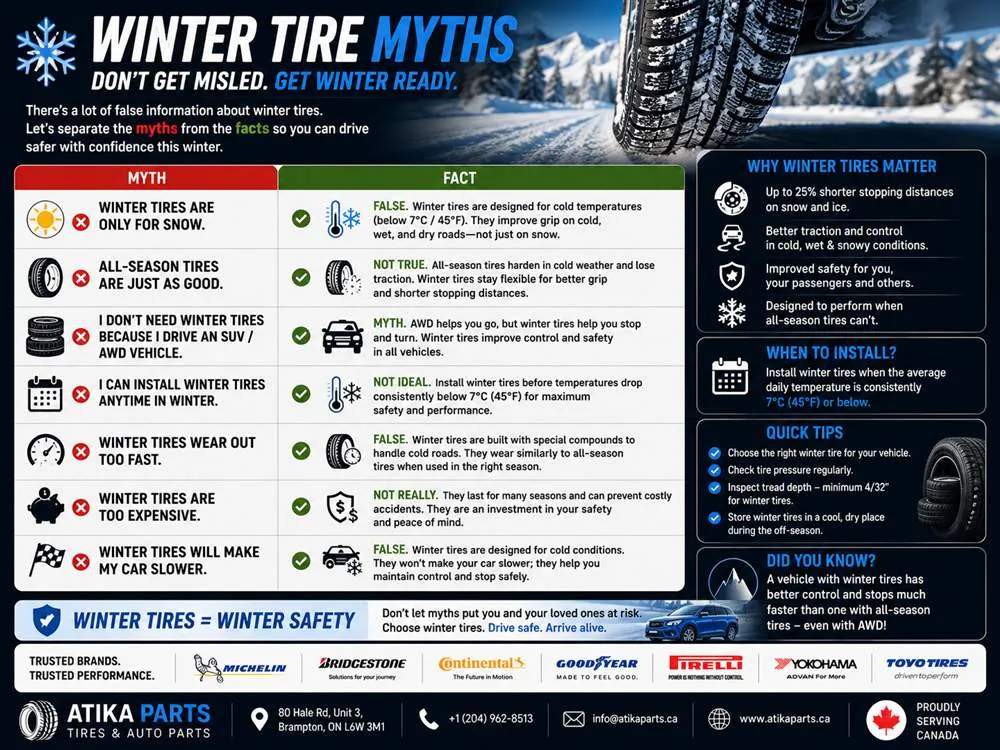
Every autumn we hear the same questions at our counter here in Brampton, and a lot of them come wrapped in myths that have been passed around GTA West driveways for years. Sorting fact from folklore around winter tires matters, because the difference shows up when you are braking on an icy 407 on-ramp or climbing a snow-covered hill in Caledon. Let us walk through five of the most common winter tire myths Ontario drivers still believe — and set the record straight.
Myth 1: All-season tires are fine for Ontario winters
This is the big one. "All-season" is one of the most misleading names in the tire world, because these tires are really built for spring, summer and fall — three seasons, not four. The rubber compound in an all-season tire hardens as temperatures drop, which means less grip exactly when you need it most.
The rule to remember is the 7°C rule: once the daytime temperature regularly sits at or below 7°C, dedicated winter tires start to outperform all-seasons — even on bare, dry pavement. That is not just about snow; it is about how the rubber stays soft and pliable in the cold. In Brampton, Mississauga and across the GTA West, we hit that 7°C threshold well before the first real snowfall. If you want the full comparison, our post on all-season vs winter tires in Ontario breaks it down in detail.
Myth 2: All-wheel drive replaces winter tires
AWD and 4WD are wonderful for getting a vehicle moving from a stop, and they help you accelerate up a slippery driveway. But here is the part the myth conveniently ignores: all-wheel drive does nothing to help you stop or steer. Braking and cornering grip come entirely from your tires and the small contact patch each one has with the road.
We see plenty of confident SUV and crossover drivers on Highway 401 who assume AWD makes them winter-proof, right up until they need to brake hard on ice. AWD plus all-season tires still stops like all-season tires. AWD plus proper winter tires is the combination that actually keeps you and your family safe. If you drive a larger vehicle, our guide to the best tires for SUVs and trucks in Ontario is worth a read.
Myth 3: You only need winter tires on the drive wheels
Fitting just two winter tires to save money is one of the most dangerous compromises a driver can make. When your front and rear axles have different levels of grip, your vehicle becomes unpredictable in exactly the conditions where predictability matters most.
- Two winter tires on the front: the rear can lose grip and swing out (oversteer), which is very hard to correct on snow or ice.
- Two winter tires on the rear: the front loses grip and you plough straight ahead when you try to steer (understeer).
Tire manufacturers and safety experts across Ontario are consistent on this: install winter tires as a full set of four. It keeps grip balanced front-to-rear so the car behaves the way you expect. For a deeper look at matching sets, see our post on whether to replace one or all four tires.
Myth 4: Winter tires wreck your fuel economy
There is a small grain of truth buried here, but the myth blows it out of proportion. A softer, more aggressive winter tread can add a very slight amount of rolling resistance compared with a hard summer tire. In practice, the difference is minor — and it is easily outweighed by the fact that a car with proper grip does not spin its wheels, slide, or get stuck.
Modern winter tires are engineered to balance traction with efficiency, and driving smoothly on tires that actually grip the road often uses less fuel than fighting for traction on the wrong rubber. If squeezing out every kilometre per litre matters to you year-round, our overview of fuel-efficient tires explains what really moves the needle.
Myth 5: Winter tires are only for heavy snow
Many GTA West drivers picture winter tires as something you only need during a full-blown snowstorm. In reality, their biggest advantage shows up on cold, dry and icy roads — the everyday conditions we drive through in Halton, Vaughan and Brampton from December through March.
This is where the 3PMSF symbol comes in. The three-peak mountain snowflake — a little mountain with a snowflake inside it, moulded into the tire sidewall — means the tire has met a specific snow-traction standard in testing. It is the mark of a genuine winter (or all-weather) tire, and it is what qualifies you for the Ontario winter tire insurance discount. Do not confuse it with the older "M+S" (mud and snow) marking, which many all-seasons carry but which does not meet the same standard.
- Look for the 3PMSF snowflake on the sidewall — that is your proof of true winter traction.
- Value brands like HAIDA offer 3PMSF-rated winter options that give great grip without the premium price.
- If you want one set for the whole year, all-weather tires carry the 3PMSF mark too and stay on year-round.
Timing matters as much as the tires themselves. Waiting for the first big snowfall usually means waiting in a queue — our guide on when to install winter tires in Ontario helps you plan ahead. You can also browse our current winter tires to see what fits your vehicle.
Get honest winter tire advice in Brampton
Winter driving in the GTA West is challenging enough without misinformation making your decisions for you. If you are unsure what your vehicle needs — a full set of dedicated winter tires, versatile all-weather tires, or simply a second opinion — come talk to the team at Atika Auto Parts. We stock brand-new, 3PMSF-rated tires, offer expert same-day fitting, and give you fair, straightforward advice.
Call us at +1 (204) 962-8513 or visit us at 80 Hale Rd, Unit 3, Brampton, ON L6W 3M1. Explore our winter tires range or contact us to book your fitting before the cold sets in.