Winter Tire Laws in Ontario: What Drivers Must Know
Published 16 Jul 2026 · Atika Auto Parts
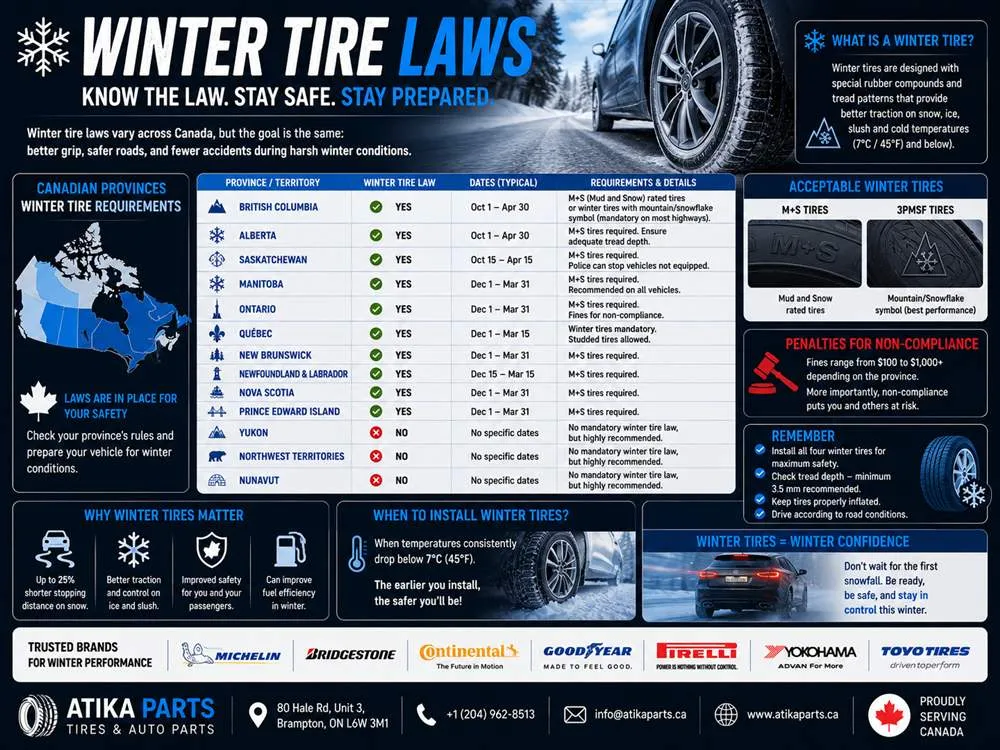
If you drive through a GTA West winter, you have probably wondered about the winter tire laws in Ontario — are they mandatory, will your insurer reward you for fitting them, and what actually counts as a "winter tire" in the first place? The short answer is that Ontario does not legally require winter tires the way Quebec does, but there is an important insurance rule on the books, and every safety authority in the province strongly recommends them once temperatures drop. Here in Brampton and across Mississauga, Caledon, Halton and Vaughan, roads swing from clear pavement to black ice within a single commute, so the practical case for winter rubber is a lot stronger than the legal one. This guide walks you through the real rules, the common myths, and how to make a smart, honest decision for your own vehicle.
Are Winter Tires Legally Required in Ontario?
Let's settle the biggest question first: no, winter tires are not mandatory in Ontario for private passenger vehicles on public roads. Unlike some jurisdictions, the province does not have a seasonal date range during which every car must switch over. You can legally drive on all-season tires through a Brampton January — though, as we'll explain, "legal" and "wise" are two very different things.
This surprises a lot of newcomers, because they have heard about Quebec's strict rule and assume Ontario mirrors it. It does not. What Ontario does have is a consumer-protection law aimed at insurance, plus a raft of official recommendations from the Ministry of Transportation (MTO). So the framework is best described as "not required, but actively encouraged" — the government nudges you toward winter tires through your wallet rather than through a fine.
The Ontario Insurance Discount Law Explained
Here is the rule that genuinely matters legally. Since 1 January 2016, Ontario has required all auto insurers to offer a discount to policyholders who install winter tires on their vehicle. This is the mandatory-offer provision: insurers must make the discount available — they are not permitted to simply ignore winter tires as a factor.
A few important details drivers often get wrong:
- The law mandates the offer, not a fixed amount. The discount typically lands around up to 5%, but the exact figure varies by insurer, vehicle and driving record.
- You usually must install a full set of four. Fitting two winter tires generally does not qualify, and for safety it is a poor idea anyway (more on that below).
- It is not automatic. You have to tell your insurer you have winter tires installed, and many will ask you to keep proof — an invoice or receipt showing four winter tires purchased and fitted.
- Coverage windows apply. Insurers commonly expect the tires to be on the vehicle through the winter months (often roughly December through March), so keep documentation of your install date.
Over several seasons, a modest 5% saving adds up — and it partially offsets the cost of a second set of tires. When you buy a set of brand-new winter tires from us, we can provide a clear itemised invoice you can hand straight to your insurance provider.
How Ontario Differs From Quebec and British Columbia
Because Canadians talk across provincial lines, it helps to know exactly how Ontario compares — especially if you drive out of province.
- Quebec has the strictest rule in the country. Winter tires are legally mandatory on all passenger vehicles from 1 December to 15 March, and the tires must carry the winter (three-peak mountain snowflake) designation. Fines apply if you are caught without them. If you regularly drive to Gatineau, Montréal or anywhere in Quebec during winter, this rule applies to you the moment you cross the border, even in an Ontario-plated car.
- British Columbia takes a different approach: winter tires (or chains) are required on designated highways — typically mountain passes and rural routes — during posted dates, usually 1 October to 30 April. It is route-specific rather than province-wide.
- Ontario sits between them with no mandate and no designated-highway rule for winter tires — only the insurance-discount offer and strong MTO advice.
The takeaway for GTA West drivers: if your winter travels ever take you into Quebec, you effectively do face a legal requirement for part of the season, so a proper set of winter tires keeps you compliant everywhere you might roam.
What Actually Counts as a Winter Tire? 3PMSF vs M+S
This is where a lot of confusion — and a lot of insurance-discount disappointment — comes from. Not every tire with "winter-ish" markings qualifies as a true winter tire.
The Three-Peak Mountain Snowflake (3PMSF) symbol is the one that counts. A tire stamped with the little mountain-and-snowflake icon has passed a standardised traction test in severe snow conditions. This is the marking Quebec law requires, the marking insurers look for, and the marking that signals genuine winter performance.
The "M+S" (Mud and Snow) marking is a much weaker signal. M+S refers mainly to the tread pattern's geometry, not to tested cold-weather grip. Many all-season tires wear an M+S stamp, yet their rubber compound hardens in the cold and they were never tested for severe-snow traction. M+S alone does not make a tire a winter tire, and it typically will not satisfy Quebec's law or an Ontario winter-tire insurance discount.
Some tires carry both markings. When you are shopping, the rule of thumb is simple:
- Look for the 3PMSF snowflake if you want true winter or all-weather capability that insurers recognise.
- Treat M+S on its own as an all-season classification, suitable for mild conditions but not deep-winter grip.
If you are still decoding the letters and numbers on your sidewall, our guide on how to read tire size breaks down every marking, and our tire speed rating and load index explainer covers the rest of the code.
Why Temperature — Not Snow — Is the Real Trigger
The most important thing to understand about winter tires is that they are misnamed. They are really cold-weather tires. Their advantage comes from a softer rubber compound that stays flexible in the cold, plus deeper tread and tiny sipes that bite into snow and clear slush.
The widely cited threshold is 7°C. Below that temperature, the compound in a typical all-season or summer tire begins to stiffen, which reduces grip on every surface — dry pavement, wet roads and ice alike. Winter tires stay pliable, so they grip better even on a clear, dry road at −5°C. That is why the MTO and safety experts frame the advice around temperature rather than the calendar: you do not need snow on the ground for all-seasons to be at a disadvantage.
In the GTA West, our shoulder seasons are exactly where this bites. A bright, dry December morning in Brampton can sit well below 7°C with no snow in sight, and that is precisely when winter tires quietly deliver shorter stopping distances. For a deeper comparison, see our post on all-season vs winter tires in Ontario.
When Should GTA West Drivers Switch Over?
Because 7°C is the guide, the practical window in Brampton, Mississauga, Caledon, Halton and Vaughan usually opens in late October or November and closes in March or early April. A sensible routine looks like this:
- Install once daytime highs consistently dip toward 7°C and overnight temperatures fall below freezing — typically around Remembrance Day for our region.
- Remove in spring once nights reliably stay above freezing and daytime temperatures hold above 7°C, usually April. Running winter tires through a warm spring wears them out faster because the soft compound isn't built for heat.
- Book early. The first heavy snowfall causes a rush at every tire shop in the GTA. Reserving your changeover ahead of time means you are not caught on all-seasons during the first storm.
For a fuller seasonal breakdown, our guide on when to install winter tires in Ontario covers timing in detail. We offer expert same-day fitting, so if the forecast turns, you can often be sorted the same day you call.
All-Weather Tires: A Legitimate Middle Ground
Not everyone wants to store and swap two sets of tires. This is where all-weather tires come in, and it is worth being clear about the difference, because the names are easy to mix up.
All-season tires are really a three-season tire; they do not carry the 3PMSF snowflake and are not designed for severe winter. All-weather tires do carry the 3PMSF snowflake, meaning they are certified for severe-snow use, yet they are engineered to run year-round. For many GTA West commuters who see mixed conditions rather than deep rural snow, a quality all-weather tire is a genuinely sensible one-set solution — and because it carries the snowflake, it can qualify for the Ontario winter-tire insurance discount.
The trade-off is honest: a dedicated winter tire will still out-grip an all-weather tire in the harshest ice-and-snow conditions, and an all-season will feel slightly crisper in high summer. All-weather sits in the middle by design. If that balance appeals to you, read our comparison of all-weather vs all-season tires in Ontario and browse our all-weather tires.
Common Winter Tire Myths in Ontario
Let's clear up a few things we hear often at the counter in Brampton:
- "Two winter tires are enough." No — mixing two winter and two all-season tires creates uneven grip between the axles, which can make a car unpredictable in a corner or hard stop. Always fit a matched set of four.
- "All-wheel drive means I don't need winter tires." AWD helps you accelerate, but it does nothing extra for stopping or steering on ice. Braking and cornering grip come from your tires, not your drivetrain.
- "Winter tires are only for heavy snow." As above, the real benefit is cold-temperature grip, which matters even on dry pavement below 7°C.
- "They're too expensive to be worth it." Running winter tires means your all-seasons rest for four months, so both sets last longer overall — and you get the insurance discount. Value brands like HAIDA make a properly certified set very affordable; see our HAIDA tire review.
Frequently Asked Questions
Are winter tires mandatory in Ontario?
No. Ontario does not legally require winter tires on private passenger vehicles. However, all insurers must offer a winter-tire discount, and the Ministry of Transportation strongly recommends winter tires once temperatures fall below 7°C.
How much is the Ontario winter tire insurance discount?
Since 2016, insurers must offer a discount for installing winter tires. It is commonly up to about 5%, though the exact amount varies by insurer. You generally need a full set of four and should keep your purchase invoice as proof.
What is the difference between 3PMSF and M+S tires?
The three-peak mountain snowflake (3PMSF) means a tire passed a severe-snow traction test and counts as a true winter tire. M+S (Mud and Snow) refers mainly to tread shape and does not guarantee cold-weather grip, so M+S alone usually will not qualify for the insurance discount.
Do I need winter tires if I drive into Quebec?
Yes. Quebec legally requires winter tires with the 3PMSF snowflake on passenger vehicles from 1 December to 15 March, and this applies even to Ontario-plated cars. If your winter travels take you into Quebec, a certified winter set keeps you compliant.
When should I install winter tires in the Brampton area?
Fit them once daytime temperatures consistently approach 7°C, which in the GTA West is usually late October or November. Remove them in spring once nights stay above freezing, typically April, to avoid wearing the soft compound in warm weather.
Can all-weather tires replace both my summer and winter tires?
Often, yes. All-weather tires carry the 3PMSF snowflake, so they are certified for severe snow and can run year-round, and they qualify for the insurance discount. A dedicated winter tire still grips better in the harshest conditions, but all-weather is a solid one-set option for many GTA West drivers.
Get Winter-Ready Tires Fitted the Same Day in Brampton
Ontario may not force you to fit winter tires, but every cold Brampton morning makes the case on its own — and the insurance discount makes it easier on your budget. At Atika Auto Parts we stock brand-new tires only, including properly certified winter tires and versatile all-weather tires from great-value brands like HAIDA, with honest pricing and expert same-day fitting. We'll provide the invoice you need for your insurer, and help you choose the right set for how and where you drive across the GTA West. Want to keep your set lasting longer? Our tire maintenance guide is a great next read. Call us at +1 (204) 962-8513, visit us at 80 Hale Rd, Unit 3, Brampton, ON L6W 3M1, or contact us to book your winter changeover today.