
Best All-Weather Tires in Canada: A Buyer's Guide
Published 14 Jul 2026 · Atika Auto Parts
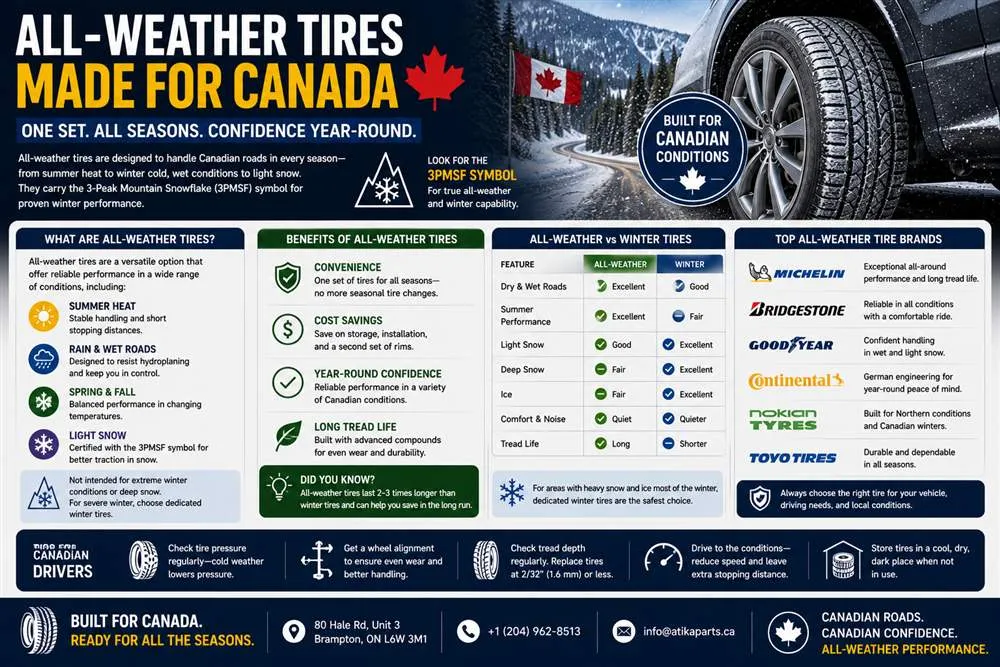
If you drive through Ontario winters, you already know how quickly conditions change — a dry morning in Brampton can turn into slush by lunch and black ice by the evening commute. Finding the best all-weather tires in Canada is about matching the right rubber to that unpredictability, so you get genuine cold-weather traction without swapping tires twice a year. All-weather tires have become one of the most popular choices for drivers across GTA West — from Mississauga and Caledon to Oakville, Burlington, Milton and Vaughan — because they carry a real winter-safety rating while still working well through spring, summer and fall. In this in-depth guide, we’ll explain exactly what all-weather tires are, how they differ from all-season and dedicated winter tires, who they suit, what to look for, and how to get them fitted properly.
What Exactly Are All-Weather Tires?
All-weather tires are a genuine year-round tire that carries the 3PMSF (Three-Peak Mountain Snowflake) symbol on the sidewall. That little mountain-and-snowflake badge is not decorative — it certifies that the tire has passed a standardized snow-traction test and meets the industry benchmark for severe snow service. In practical terms, an all-weather tire is engineered to stay flexible and grip in cold temperatures while also handling warm, dry and wet roads competently for the rest of the year.
The magic is in the rubber compound and the tread design. All-weather tires use a compound formulated to resist stiffening as the mercury drops below 7°C — the temperature at which conventional summer and many all-season compounds begin to harden and lose grip. Combined with sipes (tiny slits in the tread blocks) and biting edges that dig into snow and slush, this lets a single set of tires legally and safely carry you through an Ontario winter without the seasonal swap. Think of them as a true four-season compromise, purpose-built for climates exactly like ours.
All-Weather vs. All-Season vs. Winter: The Real Differences
This is where a lot of drivers get confused, largely because the names sound so similar. The key distinction comes down to that 3PMSF rating and the temperature range each tire is designed for. Here’s how they stack up:
- All-season tires — Despite the name, most all-season tires are really three-season tires. They carry an M+S (Mud and Snow) marking but usually do not have the 3PMSF snowflake. They’re excellent for spring through fall and handle light snow, but their compound hardens in deep cold, reducing grip when you need it most.
- All-weather tires — These carry the 3PMSF snowflake, so they’re certified for severe snow service. They stay pliable in the cold and provide real winter traction, while remaining a sensible everyday tire in warmer months. They are the middle ground — more capable in snow than all-season, more versatile year-round than winter.
- Winter (snow) tires — Also 3PMSF-rated, but built exclusively for cold. They use the softest, most aggressive compounds and deepest siping for maximum grip on ice, packed snow and slush below 7°C. On warm summer pavement, though, they wear quickly and feel vague, so they’re meant to come off in spring.
If you’d like a deeper side-by-side, our companion articles on all-weather vs. all-season tires and all-season vs. winter tires break down the trade-offs in more detail. The short version: all-weather sits neatly between everyday all-season convenience and the dedicated cold-weather bite of a true winter tire.
The Pros and Cons of All-Weather Tires
No single tire is perfect for every situation, and being honest about the trade-offs is the fairest way to help you choose. All-weather tires offer some genuine advantages, along with a few compromises worth understanding.
The advantages:
- One set, all year — No seasonal swaps, no storage headaches, no twice-yearly fitting appointments. For many drivers, that convenience is the whole appeal.
- Real winter certification — The 3PMSF rating means you’re legally and practically covered for severe snow, which matters for insurance discounts in some cases and for peace of mind on a surprise-snow morning.
- Lower storage & changeover costs — You avoid the cost of a second set of wheels and the fees or space needed to store off-season tires.
- Great for milder or unpredictable winters — Perfect for the freeze-thaw cycles and mixed conditions we see across the GTA.
The compromises:
- Not the equal of a dedicated winter tire in extreme cold — On deep ice or in sustained deep-freeze conditions, a true winter tire will still out-grip an all-weather.
- Slightly faster wear than a pure all-season — The softer, more flexible compound that gives winter grip can wear a little quicker in hot summer months.
- A modest trade in summer sharpness — Handling on hot, dry roads is very good, but a performance summer tire will still feel crisper.
Who Should Choose All-Weather Tires?
All-weather tires are a smart match for a large slice of Ontario drivers, but they’re not for everyone. You’re likely an excellent candidate if you fit one of these profiles:
- City and suburban commuters across Brampton, Mississauga and Vaughan who drive mostly on plowed, salted roads and want winter capability without the seasonal hassle.
- Drivers who lack storage for a second set of tires — condo and townhouse residents especially.
- Anyone who wants simplicity and a single, dependable set of tires managed at one shop.
- People in areas with milder or variable winters where deep snow and prolonged deep-freeze days are the exception rather than the rule.
On the other hand, if you regularly drive rural Caledon back roads in heavy snow, commute long distances before the plows come through, or spend significant time in Ontario’s snow-belt regions, a dedicated set of winter tires paired with all-season summer tires may still serve you better in the coldest, most treacherous conditions. When you need the absolute maximum ice and deep-snow traction, nothing beats a purpose-built winter tire.
What to Look For When Buying All-Weather Tires
Once you’ve decided an all-weather tire fits your driving, choosing the right one comes down to a handful of practical checks. Get these right and you’ll enjoy safe, long-lasting performance.
- The 3PMSF snowflake symbol — This is non-negotiable for a true all-weather tire. If it only shows M+S without the snowflake, it’s an all-season, not an all-weather. Always confirm the badge on the sidewall.
- Correct size, load index and speed rating — Match the specification stamped on your door-jamb placard or current tires. If those numbers look like a foreign language, our guides on how to read tire size and speed rating and load index explain every character. Getting load index right is especially important on SUVs and trucks.
- Tread depth and pattern — A deeper, more open tread with plenty of sipes clears slush and bites into snow. Look for a design built for four-season use rather than a summer-biased pattern.
- Wet grip and hydroplaning resistance — Ontario springs and autumns are wet. Good circumferential grooves that channel water away are just as important as snow traction.
- Value that fits your budget — A premium name isn’t the only path to a safe, capable tire. Well-made value brands can deliver the 3PMSF rating and dependable everyday performance at honest, fair prices.
Value Brands: Where HAIDA Fits In
Not everyone needs — or wants to pay for — the most expensive tire on the wall, and that’s completely reasonable. This is where value brands like HAIDA come in. HAIDA offers brand-new tires that deliver solid all-round performance and great value, making them a popular choice for budget-conscious drivers who still want dependable traction and a certified winter rating where available.
Across the HAIDA range you’ll find models such as the HAIDA Runspirit, HD668 and HD737, covering everyday passenger and light-truck needs. The key is choosing the right model and specification for your vehicle and confirming the ratings you need. To learn more about how these tires perform and where they make sense, have a read of our detailed HAIDA value-tire review. Whatever your budget, the goal is the same: a properly sized, correctly rated, brand-new tire fitted with care.
Why Proper Fitting and Maintenance Matter
Even the best tire only performs as well as the fitting and care behind it. A correctly mounted, balanced and inflated tire is safer, quieter and longer-lasting — and small habits make a big difference over a tire’s life.
- Precise fitting and balancing ensure smooth, vibration-free driving and even wear from day one. Our expert same-day fitting means you’re back on the road quickly.
- Correct tire pressure is the single easiest thing you can do for grip, fuel economy and tread life. Cold weather drops pressure, so check it often — our tire pressure guide for Ontario walks you through it.
- Regular rotation keeps wear even across all four corners; see why, when and how to rotate.
- Overall maintenance — from alignment to inspections — protects your investment. Our tire maintenance guide covers the habits that help tires last.
Because all-weather tires stay on your vehicle year-round, this ongoing care matters even more — there’s no seasonal changeover appointment to catch problems early, so a little routine attention goes a long way.
All-Weather or Winter? Deciding for the Coldest Conditions
Here’s the honest bottom line when the temperature really plunges. All-weather tires are a genuinely capable, 3PMSF-certified choice for the vast majority of GTA West driving, and for many households they’re the ideal balance of safety, convenience and value. But if your winters routinely involve heavy, unplowed snow, sustained deep-freeze days, or long stretches of icy rural roads, a dedicated winter tire will still give you the maximum possible traction when it matters most.
A practical way to decide: if your worst-case winter day is a slushy, salted commute, all-weather tires will handle it comfortably. If your worst-case is a pre-dawn drive down an unplowed concession road in a deep freeze, lean toward a winter set. Timing matters too — if you do choose winter tires, our guide on when to install winter tires in Ontario helps you get ahead of the first snowfall. Either way, we’re happy to talk through your specific driving and help you choose honestly.
Frequently Asked Questions
Are all-weather tires good for Canadian winters?
Yes. All-weather tires carry the 3PMSF snowflake symbol, which certifies them for severe snow service, so they provide real winter traction and stay flexible in the cold. They’re a great fit for GTA West winters, though a dedicated winter tire still offers more grip in extreme ice and deep snow.
What is the difference between all-weather and all-season tires?
All-weather tires have the 3PMSF snowflake and are built to grip in cold and snow year-round. Most all-season tires only carry an M+S marking and no snowflake, so their compound hardens below 7°C and they’re really best for spring through fall with only light snow.
Do I still need winter tires if I have all-weather tires?
For most Brampton and GTA West commuters driving on plowed, salted roads, all-weather tires are enough. If you regularly drive heavy unplowed snow or long icy rural routes in deep cold, a dedicated set of winter tires will give you the best possible traction.
Are HAIDA all-weather tires a good value?
HAIDA offers brand-new tires that deliver dependable performance at honest, fair prices, making them a popular value choice. The key is selecting the right model and specification for your vehicle and confirming the ratings you need — our team is glad to help you match the right tire.
How do I know if a tire is a true all-weather tire?
Look for the Three-Peak Mountain Snowflake (3PMSF) symbol on the sidewall. If the tire shows only M+S without the snowflake, it’s an all-season tire, not an all-weather. The snowflake badge is your confirmation of certified severe-snow capability.
Can I get all-weather tires fitted the same day in Brampton?
Yes. At Atika Auto Parts on Hale Road in Brampton, we offer expert same-day fitting on brand-new tires, including balancing, so you’re back on the road quickly. Call ahead or contact us to check availability for your size.
Get the Right All-Weather Tires Fitted Today in Brampton
Ready to simplify your seasons with a certified, capable tire? Explore our full range of brand-new tires, including all-weather tires and dedicated winter tires for the coldest conditions. Our team will help you match the right size, load rating and value brand to your vehicle and budget, then get you set up with expert same-day fitting. Call us at +1 (204) 962-8513, drop by 80 Hale Rd, Unit 3, Brampton, ON L6W 3M1, or contact us to book. We proudly serve drivers across Brampton, Mississauga, Caledon, Halton and Vaughan — all of GTA West.